
 17 min read




Key Takeaways
- Identify the exact duct systems, test sections, and construction stages covered by the bid.
- Record the required test method, pressure, acceptance basis, and document references without inventing missing criteria.
- Separate duct leakage testing from balancing, equipment startup, controls testing, and commissioning activities.
- Assign temporary closures, access, attendance, repairs, retests, and reporting to named scope holders.
- Price the agreed test events and visits, keeping unresolved conditions and comparison adjustments visible.
Your ductwork takeoff is complete, and the testing subcontractor has returned a lump sum. Then the project team asks for witnessed tests on several floors before ceilings close. The quote covers one final visit. The duct quantities have not changed, but the testing scope and the work needed to support it are different.
A useful duct leakage testing estimate starts with a scope register. It identifies what will be tested, how the project defines acceptance, who prepares each section, and when the testing team must attend. You can then compare offers against the same work instead of treating every testing allowance as equivalent.
This workflow supports estimating and coordination. The actual project specifications, applicable requirements, approved test plan, and responsible professionals govern technical criteria and test procedures. All section counts and labor quantities below are fictional estimating examples. They are not leakage limits, test pressures, or instructions for operating test equipment.
1. Separate leakage testing from other HVAC checks
Build distinct estimate lines for the activities named in the documents. Duct leakage testing evaluates air leakage under the specified test conditions. Testing, adjusting, and balancing, often shortened to TAB, addresses system airflow and related adjustments. Equipment startup, controls verification, and commissioning can introduce further responsibilities and records.
Do not assume that a TAB quotation includes leakage testing because both activities involve air measurements. Ask the bidder to identify the services included, the systems covered, and the required deliverables. If a combined provider offers several services, preserve separate scope descriptions so you can review gaps and overlaps.
Likewise, a duct installation price may include normal fabrication and sealing while excluding independent testing attendance or temporary test preparation. Read the scope sheet and specification together. Record who owns the installation quality work and who supplies each testing service before you apply a subcontractor total.
The HVAC takeoff checklist provides the broader review of ductwork, equipment, controls, piping, and insulation. The register developed here supplies the testing-specific boundaries and attendance assumptions that a general material takeoff cannot establish on its own.
2. Find the governing requirements and their revision
Read the ductwork and testing specifications, mechanical notes, equipment schedules, commissioning requirements, bid instructions, and relevant addenda. Record the actual section number and paragraph for each obligation. Do not assume a requirement appears in the same specification location on every project.
Create fields for the referenced test method and edition, required test extent, test stage, pressure basis, acceptance criteria, witnessing, qualifications, report content, and corrective-work obligations. Where a field remains blank, connect it to a clarification item. A familiar standard name does not answer every project-specific question.
The ANSI-hosted preview of SMACNA's 2012 leakage test manual distinguishes duct leakage from equipment and accessory leakage and explains that seal class does not itself establish a leakage rate. Use the contract's actual criteria and referenced edition; do not substitute a generic label for the specified acceptance basis.
Preserve units exactly as issued. A pressure entry needs its unit and source, while an airflow quantity needs its own unit and basis. If documents use different unit systems or inconsistent values, request resolution. The estimator should not choose the more convenient value or silently convert an uncertain criterion into a bid assumption.
Keep the requirement register dated. An addendum can change the percentage or sections tested, the witness requirement, or the reporting format without changing the duct layout. A materials-only revision review would miss that change, so include specification updates in the testing scope comparison.
3. Define each test boundary on a marked plan
Assign a unique identifier to each proposed test section or whole-system test required by the project. Include building, level, system, service, and start and end boundaries. The identifier should connect the markup to the estimate line and eventually to the report requested from the testing provider.
A label such as AHU-01 can cover several duct branches and different conditions. Identify whether the quoted work includes a particular trunk, riser, branch group, or another approved boundary. Keep supply, return, exhaust, and outside-air systems distinguishable where their requirements differ.
Record what lies inside each boundary. Duct-mounted devices and equipment can affect how a test is defined and prepared. Ask the responsible team to confirm their treatment in the approved plan. Do not assume every component can be included in the same test or temporarily sealed in the same way.
Keep isolation and temporary closure decisions with the responsible installer and test provider under the approved procedure. Your estimate can identify a closure location and assign its scope, but it should not prescribe an unreviewed method. Avoid assumptions that interfere with listed dampers or other devices.
Where testing extent is specified as a percentage, retain the stated denominator and selection rule. A percentage of duct length, a percentage of surface area, and a selection of systems are different bases. Ask who selects the sample and whether any additional testing follows an unsuccessful result.
4. Use a test-section register to expose missing information
Keep one row for each defined section and construction stage. Include the source drawing, specification reference, boundary, planned readiness, temporary preparation, test provider, witness, report requirement, and status. Separate a defined obligation from a proposed estimating assumption.
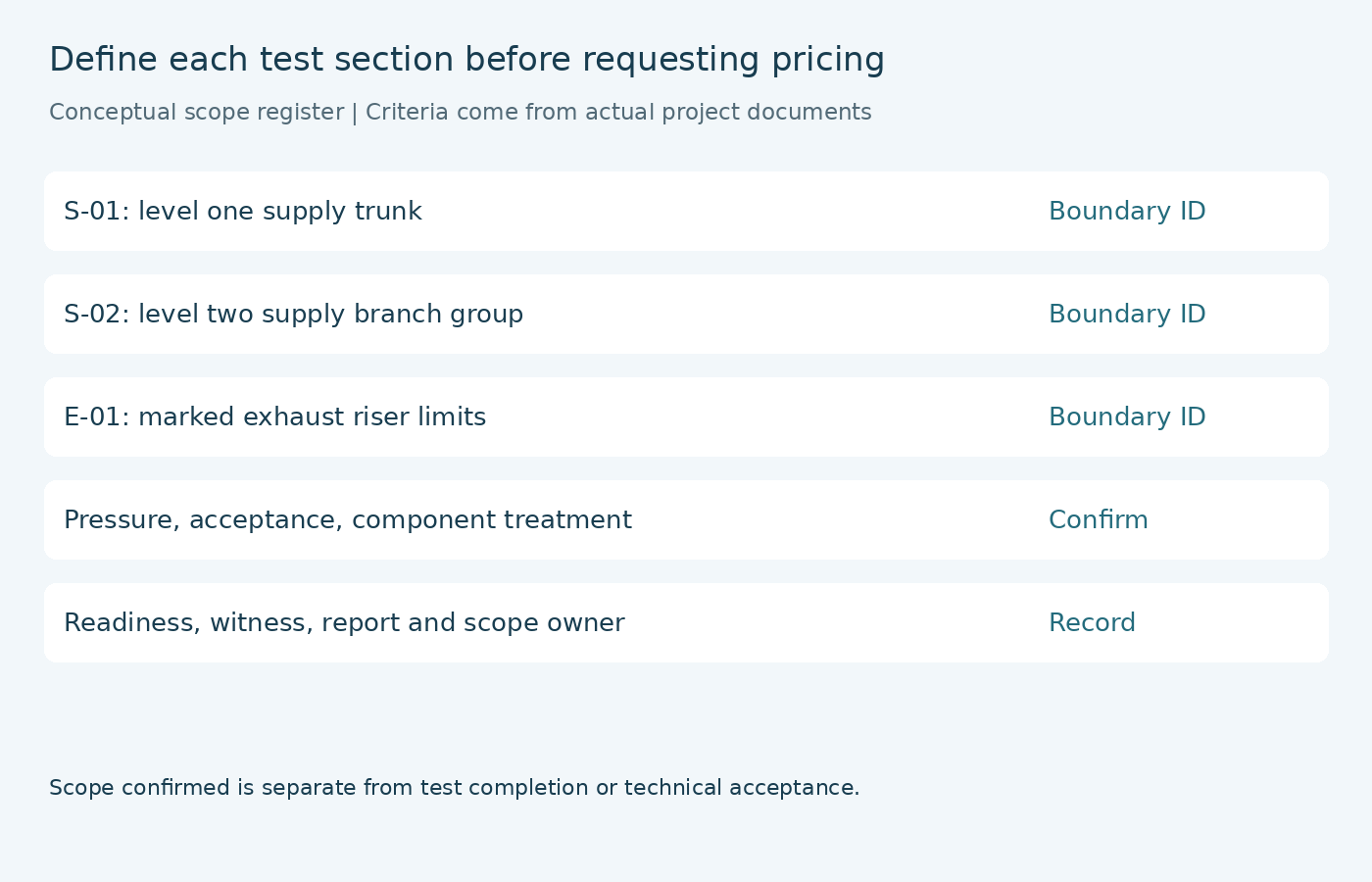
For a fictional project, consider three sections: S-01 on level one supply, S-02 on level two supply, and E-01 on an exhaust riser. The example does not assign pressures or leakage limits. Those cells remain linked to the project documents or clarification log until the responsible team confirms them.
| Section | Boundary description | Estimating review item |
|---|---|---|
| S-01 | Level one supply trunk between marked boundaries | Confirm readiness before ceiling closure |
| S-02 | Level two supply branch group | Confirm whether attendance can share a visit |
| E-01 | Exhaust riser within the identified limits | Confirm access and component treatment |
A simple table is useful when it points to actual markups. Keep a boundary note for every section, including any equipment or accessory exclusions. If two reviewers interpret the same section differently, resolve the limits before comparing prices.
Add review status without implying technical acceptance. “Scope confirmed” means the bid boundary has been agreed. It does not mean the installation has passed a test. Use separate fields for estimating status, test completion, reported result, and any required approval or acceptance.
5. Measure the work needed to prepare and restore sections
List the assigned temporary preparation tasks for each section. Depending on the approved plan and package boundaries, these may involve closures, access provisions, setup assistance, temporary connections, protection, and restoration after testing. Have the installer and test provider identify the actual work.
Keep counts tied to locations. If a section has several open ends or interfaces, record each assigned item and the responsible party. A single percentage applied to duct installation labor will not explain whether you have included the actual preparation required for a staged test.
Separate temporary items from permanent installation. A temporary closure or connection may be removed after the test, while a specified access provision can remain part of the finished system. Confirm what the bid requires and ensure that neither item disappears between the sheet-metal and testing quotations.
Consider restoration in the same review. Who removes temporary materials, reconnects the system, and completes assigned finishes or insulation after the required work? Keep those responsibilities visible without assuming that the testing provider performs all installation tasks.
Do not add a generic closure count as an engineering instruction. The register is a quantity and responsibility record. The approved test plan and manufacturer requirements determine how components are protected, isolated, or restored. The estimate should carry that work on the agreed basis.
6. Distinguish test events, visits, and working hours
A test event is a defined occurrence for a section or system under the project requirements. A visit is an attendance period at the site. Several events may fit within one visit, while one event can require more than one attendance if the work is interrupted or the agreed scope changes.
Build the estimate around those separate quantities. Count the defined initial events, identify planned visits, then apply supported crew and equipment assumptions. Obtain productivity and duration inputs from the provider or contractor. Do not invent an industry-wide number of sections tested per day.
For illustration, suppose six initial test events are planned across three visits. The quote should state whether it covers all six events and three mobilizations. Another quote covering six events in one uninterrupted visit describes a different attendance basis, even if both bidders use a lump sum.
Show witness waiting, restricted hours, and access interruptions only where they have a stated basis. Record whether the quotation includes an allowance, an hourly rate, or an exclusion for those conditions. An unexplained extra day can conceal an unresolved readiness problem that needs coordination.
Keep normal setup and reporting time distinguishable from field measurement time where the provider's offer supports that breakdown. The goal is a scope you can trace, not a forced division of a legitimate lump sum. Ask for enough detail to assess the actual differences between offers.
7. Work a transparent attendance example
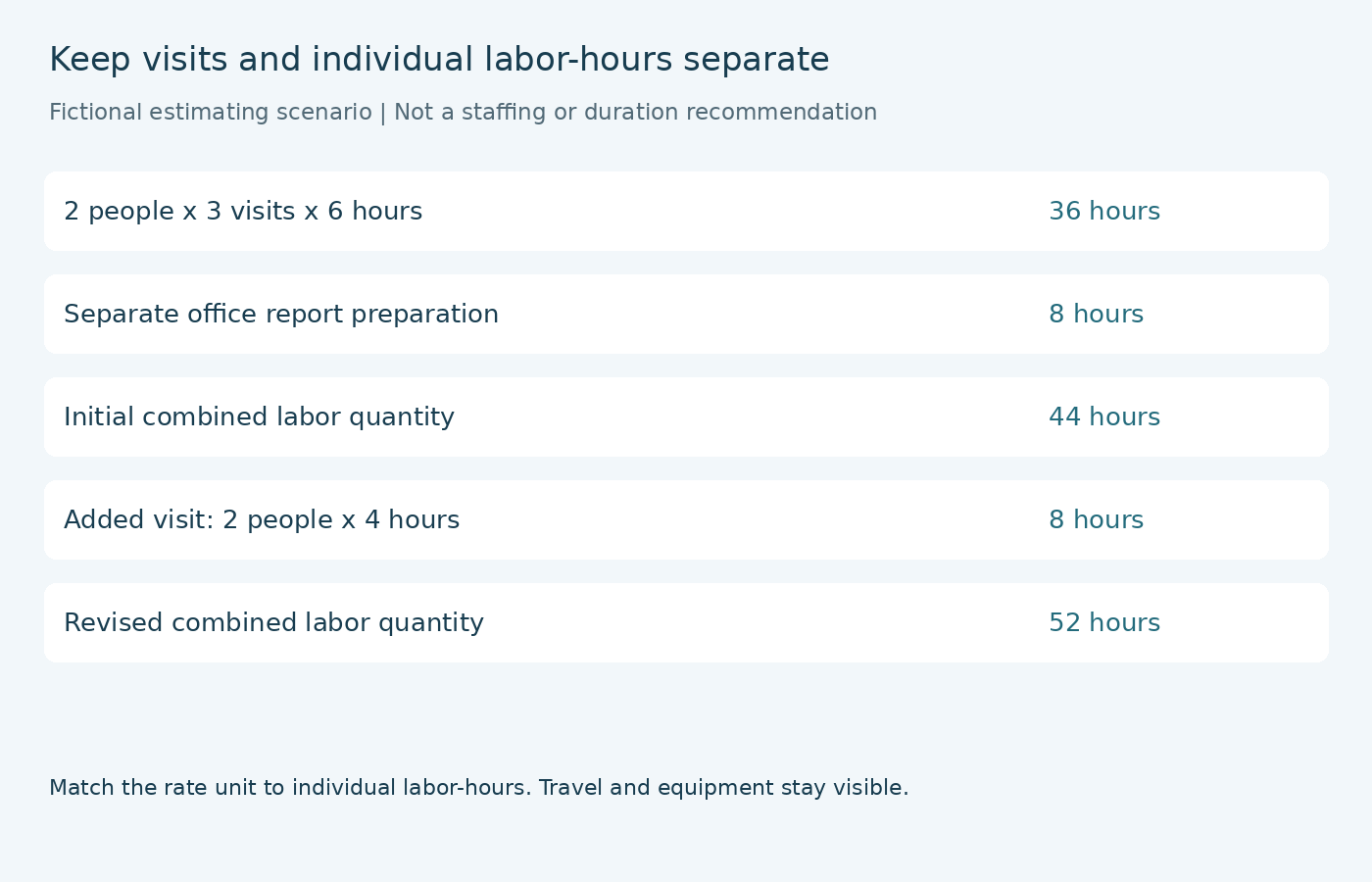
Assume a fictional estimating plan calls for two technicians attending three visits of six on-site hours each. The field attendance quantity is 2 × 3 × 6 = 36 labor-hours. This example describes a chosen estimating scenario; it is not a recommended staffing level or duration.
Suppose the provider separately identifies eight office labor-hours for its assigned report preparation. The visible labor quantity becomes 36 field labor-hours plus 8 office labor-hours, or 44 total labor-hours. Preserve the categories so a change in visits does not automatically change the reporting allowance.
If a separately authorized extra visit uses the same illustrative two-person crew for four hours, it adds 2 × 4 = 8 field labor-hours. The revised total becomes 52 labor-hours, with three original visits and one added visit. Check actual provider terms before using this structure for pricing.
| Activity | Illustrative quantity basis | Labor-hours |
|---|---|---|
| Initial field attendance | 2 people × 3 visits × 6 hours | 36 |
| Report preparation | Separate assumed office quantity | 8 |
| Initial combined quantity | 36 + 8 | 44 |
| Additional authorized attendance | 2 people × 1 visit × 4 hours | 8 |
| Revised combined quantity | 44 + 8 | 52 |
Travel, equipment, consumables, and commercial minimums remain separate review items unless the quote includes them in the stated rate. Do not multiply 44 by a crew rate intended to cover two people if the 44 already represents individual labor-hours. Match the unit of the rate to the unit of the quantity.
8. Plan testing around readiness and the construction sequence
Connect the test register to the actual program. Record when the section is expected to be complete, accessible, and available for the required preparation. Coordinate that milestone with the people managing ceilings, insulation, equipment connections, and adjacent work.
A planned visit is only workable if the relevant sections are ready together. If one floor is available while another remains incomplete, the provider may need a different attendance plan. Show that dependency before accepting a quote based on one continuous sequence.
PNNL's central ventilation and exhaust leakage-testing guide distinguishes rough-in and final testing and discusses sequencing leakage testing before balancing to reduce repeat work. Its program-specific criteria are not universal commercial-project requirements. Use it to understand the coordination issue while following your own project's required sequence.
Agree how readiness will be confirmed and who authorizes attendance. A written release can identify the sections ready for the next visit and any known limits. That record helps distinguish a provider's planned work from a return caused by unavailable access or unfinished installation.
Also identify witness notice and scheduling requirements from the documents. A witness may have availability constraints independent of the testing contractor. Carry the actual notice and attendance obligations into the scope register; do not promise a review period or inspection date that nobody has confirmed.
9. Assign repairs and retests without assuming failure
Read the contract and quotation to establish responsibility for corrective sealing, diagnostic work, retesting, and reports after an unsuccessful result. Do not assume every return is included in a base testing price. Equally, do not assume every return is automatically an extra payable item.
Separate three possible causes in the comparison: an unsuccessful initial test, a section that was not ready, and a later change to previously completed work. They can involve different scope responsibilities and commercial treatment. Record the actual terms instead of combining them under a vague “retest allowance.”
Where the bid instructions allow a provisional allowance or unit price, label it clearly. Define what an added visit or event includes and what triggers its use. The quantity should remain an estimating assumption until the relevant event occurs and the project authorizes the work under its process.
Do not invent a failure rate or state that a particular number of sections will require retesting. If the contractor has relevant documented history, it can support an internal risk assessment, but keep that assessment separate from measured work and contractual obligations.
Maintain the original section ID through corrective work and retesting. Add the attempt number, date, related issue, and required report reference. That history supports review without creating the impression that a second report belongs to an entirely different section.
10. Build a responsibility matrix before leveling quotes
List preparation, measurement, witness coordination, access equipment, electrical supply, installation support, corrections, restoration, and reporting as separate scope questions. Assign an owner only when the documents or written clarification support it. Mark unassigned items for resolution.
A testing provider may supply instruments while the installing contractor supplies access and temporary preparation. Another offer may include a broader service. Both can be legitimate, but the estimate needs to carry the full assigned package once. Retain those boundaries beside the price comparison.
Check access equipment especially carefully in high or congested areas. Determine whether the quoted service includes the required lift or relies on another contractor's equipment. Any shared-equipment assumption needs coordination, availability, and commercial treatment; it should not silently remove a real resource from the estimate.
For a combined mechanical package, compare this matrix with the mechanical bid review checklist. Look for testing or support costs already included elsewhere. A separate leakage-testing line should improve visibility without charging the same attendance or equipment twice.
11. Request comparable quotations and useful deliverables
Send the current specifications, marked boundaries, section register, proposed sequence, and open questions to each bidder. State whether you need a budget allowance or a firm quotation against a defined scope. Ask each provider to identify assumptions that affect the price or schedule.
Request confirmation of included events, visits, working hours, qualifications, equipment, witness attendance, reporting, and retest terms. Keep the provider's original offer unchanged. Document any comparison adjustment separately with its source and the reason it is needed.
Identify the report content required by the actual project. Your request can ask the bidder to confirm coverage for section identifiers, boundaries, dates, criteria references, instrument information, measured results, and required signatures or review. Avoid inventing a universal report form or certification requirement.
For scopes that remain incomplete, ask a targeted question. “Does your quote include the three marked visits before ceiling closure?” is easier to answer than “Please include everything.” Record the written response and update the comparison so the chosen offer and final bid basis agree.
Do not choose a provider solely from the lowest unadjusted total. First establish whether the offer covers the issued requirements and workable attendance plan. Commercial selection belongs to the contractor's process, with capability, scope, and terms reviewed alongside price.
12. Reconcile the testing allowance before submitting the bid
Check every system named in the specifications against the test register. Confirm that any sampling rule has a defined source and that the proposed boundaries follow the reviewed plan. Review equipment and accessory treatment, missing criteria, and any section counted in more than one group.
Then reconcile the register to the quote and estimate. Initial events, visits, provider scope, installation support, and reporting should be visible. Check whether taxes, freight, travel, access equipment, and other commercial items are included, excluded, or carried elsewhere according to the actual proposal.
Keep unresolved items in the bid qualifications or clarification process required by the project. A test pressure or acceptance limit that is missing from the documents is not a minor spreadsheet omission. It can change the scope being priced, so the estimate should show what remains unconfirmed.
BidAccurate's HVAC estimating services can organize testing and balancing boundaries with ductwork, equipment, installation labor, and agreed vendor pricing. Provide the current plans, specifications, scope sheet, and quotations so the review can follow the actual package and identify missing inputs.
Conclusion
Define leakage testing by system, section, criteria, stage, and responsibility before comparing prices. Keep test events separate from site visits, preserve the provider's written assumptions, and show preparation, returns, and reporting clearly. The resulting scope register gives the bid team a traceable basis for its allowance and a practical record to update as the work develops.
Frequently Asked Questions
Is duct leakage testing included in TAB?
Check the actual quotation and specifications. Leakage testing and testing, adjusting, and balancing are distinct activities, even when one provider offers both. Ask the bidder to identify the systems, events, visits, and deliverables included in each service.
Can seal class be used as the leakage acceptance limit?
Do not treat the terms as interchangeable. Record the project's required leakage acceptance basis and test conditions separately from its sealing requirements. If the documents do not provide enough information, request clarification from the responsible project team before finalizing the scope.
Should I price one test for each air-handling unit?
An equipment tag alone may not define the test boundary or number of required events. Review the specified extent, pressure conditions, stages, and approved section plan. Count the required work from those limits and confirm the bidder uses the same basis.
How should return visits be carried in the estimate?
Identify why a return may occur and follow the contract and provider's written terms. An unsuccessful test, incomplete readiness, and a later scope change can have different treatment. Keep any permitted allowance or unit price separate from confirmed initial work.
Can I assume all sections will be ready for one visit?
Only use that assumption when the construction sequence and responsible team support it. Check access, completion, witness availability, and related work. If readiness differs by floor or phase, request a quotation based on the actual planned attendance.
Does a successful test mean the complete HVAC system is accepted?
Acceptance depends on the project's full requirements and review process. A leakage report concerns its defined boundary and conditions. It does not replace other required startup, balancing, controls, commissioning, or closeout activities. Keep those statuses separate in the register.
What information should accompany a testing quotation request?
Send current specifications, marked section boundaries, criteria references, proposed stages and visits, responsibility notes, and unresolved questions. Request confirmation of preparation, access, attendance, reporting, and return terms so the offers can be compared against the same scope.