
 12 min read





Key Takeaways
- Identify the changed instruction and the original scope before developing a cost proposal.
- Show added work, deleted work, and unaffected costs separately.
- Support quantities, resource assumptions, and supplier quotations with traceable records.
- Check retained costs, time effects, and markup against the actual contract.
- Reconcile the proposal summary to its backup and preserve every revision.
A revised detail arrives after your subcontract is signed. The new assembly costs more, but part of the original work disappears. Your supplier has already shipped some materials, and the field team has completed preparation that the revised detail still needs. Simply subtracting the old estimate from a new estimate can hide those retained costs and give the reviewer a credit that does not match the work.
A clear change-order estimate explains the movement from the agreed scope to the revised scope. You need a supported account of what is added, what is removed, and what continues. Keep that account separate from the contractual decision about authorization, entitlement, and payment. A complete worksheet helps the project team review the proposal; it does not establish a right to recover every listed amount.
Identify the instruction and the pricing basis
Start with the document that triggered the review. Record the change reference, date, issuing party, affected drawings and specifications, and the requested pricing response. Attach the relevant instruction or correspondence so the reviewer can see the scope you were asked to evaluate.
Check the actual contract process for changes, notices, authorization, and supporting records. Requirements vary with the agreement and applicable project rules. Route contractual questions to the responsible contract administrator rather than assuming that a revised drawing alone authorizes extra work or guarantees payment.
For one federal example, FAR 52.243-4 addresses specified changes and adjustments under that clause. Its procedures and conditions belong to contracts incorporating it, including applicable deviations. Do not apply its notice periods or adjustment provisions automatically to a private project or a different federal contract.
State the estimate's basis and limits. Identify whether you are pricing a proposed change before work, documenting actual resources after direction, or revising an earlier proposal. List unresolved scope items and the information needed to close them. A reader should be able to distinguish a priced assumption from an agreed instruction.
Freeze the original scope before measuring the revision
Collect the executed scope, referenced drawings, specifications, accepted clarifications, and relevant previous changes. Preserve the estimate and supplier offers used as supporting information, while recognizing that an internal bid estimate is not always the governing contractual scope definition.
Match the original and revised conditions by building, level, room, system, or another useful location reference. If the revision affects only one area, keep unrelated work out of the change worksheet. Pricing the whole trade again can obscure the actual difference and introduce changes unrelated to the instruction.
Record the drawing issue on every takeoff line. Follow changed details into schedules, sections, and specifications. A substituted door can affect hardware, frame preparation, finishes, and installation work. Measuring the visible door count alone may miss resources that changed with the assembly.
Use the drawing-revision quantity log to preserve adds and deletes against a known baseline. The quantity log supports the cost proposal, but it should remain readable on its own so a reviewer can check measurements before discussing rates.
Separate adds, credits, and unchanged work
Give added work positive quantities and identify deleted work in a separate credit section. Use a consistent sign convention in the summary. Keep the unit beside each quantity and explain whether it represents net installed work, a procurement allowance, or an actual purchase commitment.
For deleted work, identify the resources that will actually be displaced. Review material orders, fabrication status, installation progress, and related supplier terms. Costs already incurred or still needed require their own explanation and contractual review; they should not disappear inside an unexplained reduced credit.
Keep unaffected work visible as a scope boundary without charging it again. For example, a replacement finish may still use the same completed substrate preparation. Identify the retained preparation and check whether the added assembly price already includes it before carrying a separate cost.
Separate relocation from a simple deletion and addition when the work includes removal, handling, protection, or reinstallation. Document those activities and their resource basis. Do not assume that moving one installed item costs the same as installing one new item under the original sequence.
Build materials from supported quantities
Measure the changed assemblies using the project's dimensions and specified products. Retain the calculation, deductions, and location references. Explain changed thicknesses, lengths, counts, or coverage rather than supplying only a final material amount.
Convert net quantities to purchasing quantities separately. Identify justified cuts, handling allowance, packaging, minimum orders, and supplier rounding. A supplier's quotation may already include some of those provisions. Adding a second blanket allowance can duplicate material that is already priced.
Request dated quotations tied to the correct specification and revision. Record included accessories, freight, taxes where applicable, exclusions, and delivery assumptions. Preserve the supplier's actual offer and identify any internal adjustment as an estimating assumption requiring confirmation.
For removed materials, check returnability, cancellation charges, restocking terms, and salvage treatment through actual records and the contract. Never invent a default percentage. If the supplier has not confirmed a return or credit, show its status and seek the information needed for a supported proposal.
Explain labor and equipment assumptions
Break changed labor into recognizable activities. Preparation, removal, access, installation, testing, and cleanup can require different crews or conditions. Connect the hours to measured work and the actual method being priced, including the source of any productivity assumption.
State the labor-rate basis and identify included burdens or other components as required by the contract and proposal format. Check whether a subcontract quotation already includes those costs. Applying an additional labor burden to a complete subcontract offer can count the same component twice.
Identify equipment by its required use and duration. Explain mobilization, minimum rental periods, standby assumptions, operators, fuel, and delivery where they are part of the proposal. Compare those items with equipment already available for the unchanged work before charging another complete mobilization.
When work has occurred, retain contemporaneous records appropriate to the project. Daily reports, timesheets, equipment records, delivery tickets, and signed field documentation can support the resources reported. Check what each signature acknowledges; a field record does not necessarily constitute agreement on price or entitlement.
Use a quantity bridge before the cost summary
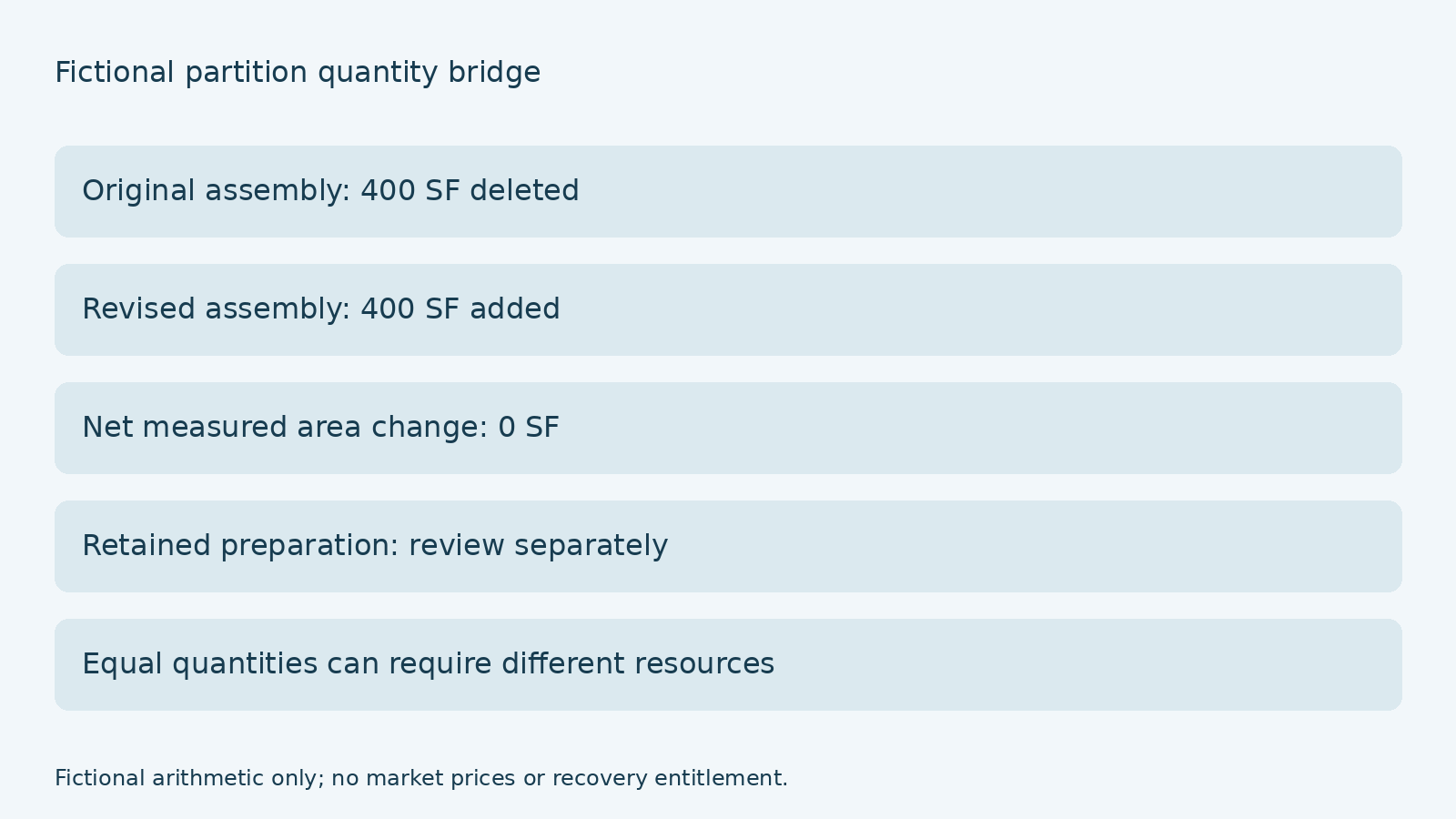
Consider a fictional partition substitution affecting a 40-foot wall that is 10 feet high. For this arithmetic example, assume both the original and revised scope use the same defined 400-square-foot measurement basis. The original assembly is removed from the change scope, and the revised assembly is added.
The quantity bridge therefore shows 400 square feet deleted and 400 square feet added, with zero net change in measured wall area. That zero does not imply zero cost difference because the assemblies and resources differ. Describe each assembly and measure its associated components on the correct basis.
Assume the fictional review also confirms that completed preparation remains suitable for the revised work. Keep that preparation in the unchanged category and check both assembly build-ups for duplication. If the new detail requires additional preparation, measure and explain that additional activity separately.
| Fictional scope line | Quantity | Proposal treatment |
|---|---|---|
| Original partition assembly | 400 SF deleted | Supported displaced-resource credit |
| Revised partition assembly | 400 SF added | Supported revised-resource cost |
| Completed preparation still required | Retained scope | Check for duplicate inclusion |
Use actual supported pricing for a real proposal. This example supplies no market rates or recoverability conclusion. Its purpose is to show how equal quantities can still represent different resource requirements and why retained work needs an explicit review.
Reconcile a supported cost bridge
After quantities are checked, group the supported costs in a summary that preserves the separate additions and credits. Keep material, labor, equipment, and subcontract components identifiable at the level required by the project. Reference each summary line to its backup.
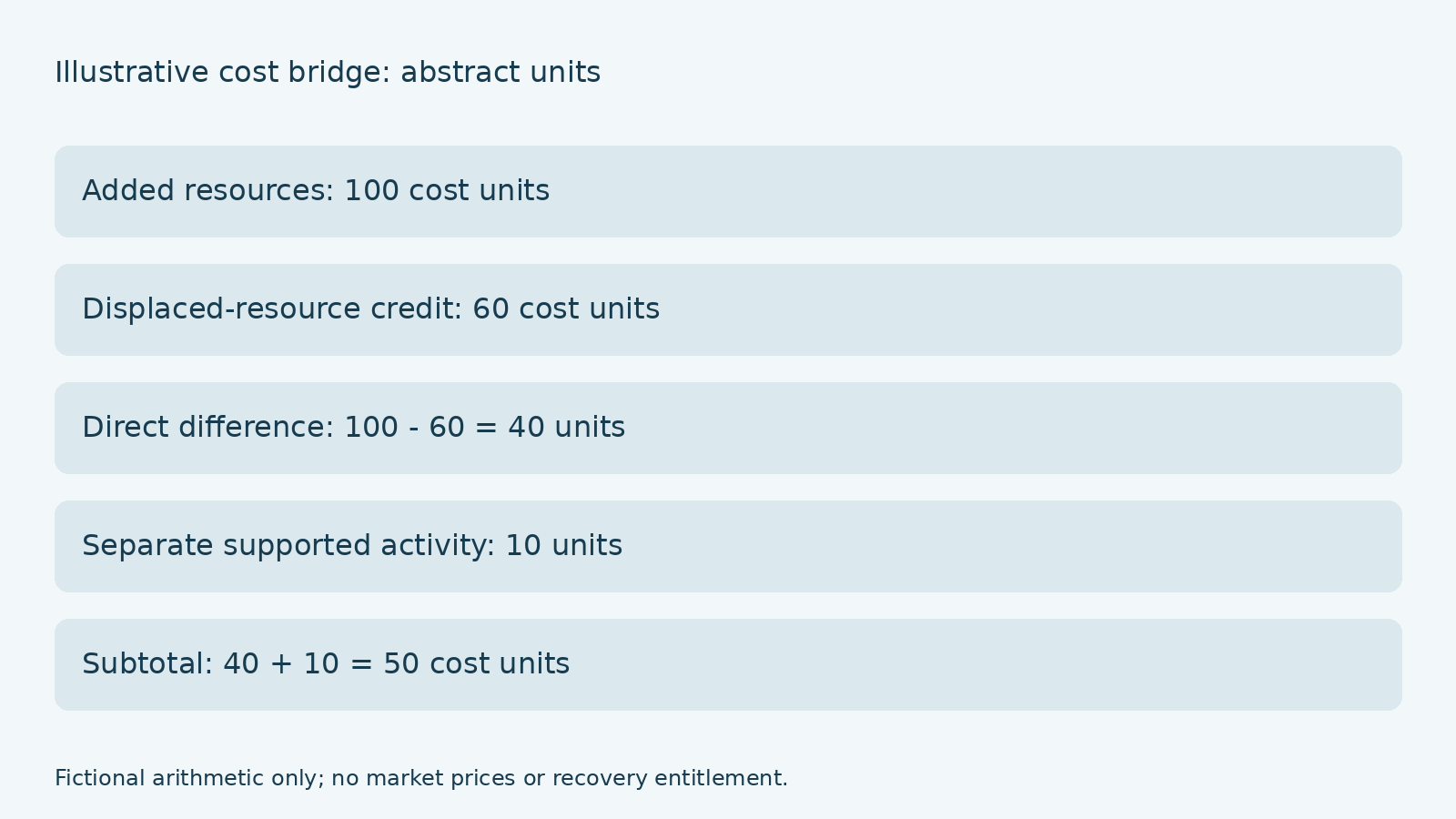
For arithmetic only, suppose a fictional reviewed worksheet contains 100 cost units of added resources and 60 cost units of supported displaced resources. The direct-cost difference is 40 cost units. These are abstract calculation inputs, not dollars, market prices, or an example of an agreed commercial entitlement.
If another 10 cost units represent a separately supported change activity, identify that activity and check that it appears nowhere else. The resulting direct-cost subtotal becomes 50 cost units before any separately reviewed contractual adjustments. Keep unresolved items outside an agreed subtotal unless the proposal clearly identifies their assumed treatment.
Do not hide the original gross amounts by reporting only the net. A reviewer needs to check whether the 60-unit credit is complete and whether the added 10-unit activity duplicates a resource already included in the 100-unit addition. Preserving the bridge makes those checks possible.
Review retained and time-related costs separately
A scope change can affect sequencing, access, temporary work, or the period during which resources are needed. Identify the claimed relationship between the instruction and each additional activity. A general statement that the job became harder does not explain which resources changed.
Keep time effects connected to the project schedule and the responsible review process. State the activities, dates, dependencies, and assumptions used. A cost estimate alone does not prove a critical-path delay or establish an extension of time.
Review temporary protection, supervision, facilities, and repeated mobilization against the original allowance and actual need. Some resources may remain necessary for unchanged work. Explain the incremental portion being proposed and avoid charging the entire original project expense again.
Separate unresolved time impacts from a fully defined direct-cost proposal where the contract and review process permit that approach. State reservations and exclusions through the authorized contractual process. Do not assume that a note on a worksheet overrides release language or other terms.
Apply the contract's treatment of adjustments
Check the applicable provisions for overhead, profit, bonds, insurance, taxes, subcontract markups, and credits. Identify the permitted calculation base and any restrictions. There is no universal markup percentage or automatic right to apply every adjustment to every component.
Keep the order of calculations visible. A percentage applied to an addition may need different treatment from a credit or a subcontract amount. Show the base and reference the actual contractual basis rather than using a familiar spreadsheet formula without checking its meaning.
The federal Change Order Accounting clause illustrates a contract-specific requirement for separate allocable cost records when applicable. Its use and conditions must be checked in the actual contract. Maintaining traceable change records is useful estimating practice without claiming that this clause governs every construction project.
Have the responsible project team review commercial and contractual treatment before submission. The estimator can organize quantities and resources, while authorized reviewers resolve questions about recoverability, notices, releases, and agreement. Keep those decisions documented with the proposal revision.
Check backup and preserve the revision trail
Reconcile every summary amount to the detailed worksheet and attached records. Confirm that additions and credits use the intended signs, units remain consistent, and supplier totals match the offers attached. Check formulas after inserting or deleting rows.
Ask a reviewer to trace one changed assembly from instruction to measurement, resource build-up, and summary. Then check the retained work and credit independently. This review can reveal a missing accessory or a duplicated preparation line that a top-level total would not expose.
Issue each proposal with a revision identifier, date, scope description, assumptions, exclusions, and attachment list. Preserve earlier submissions and written clarifications. If a negotiated amount changes the breakdown, retain the agreement and distinguish it from your original estimate.
After approval through the project's required process, transfer the agreed scope and cost coding to purchasing and field teams. Keep the final change reference connected to the budget and relevant records. An accepted summary should not leave the team working from a superseded scope attachment.
Conclusion
A reviewable change-order estimate begins with the original scope and the changed instruction. Measure the adds and deletes, support the resources, and explain retained work before applying the contract's required adjustments. Keep the quantity and cost bridges visible through submission and agreement.
For help organizing the estimating backup, share the original documents, revision, quotations, and requested proposal format with BidAccurate's construction estimating team. Agree on the deliverable and the project team's review responsibilities before pricing starts.
Frequently Asked Questions
What should a change-order estimate include?
Include the instruction, original scope basis, changed quantities, supported resources, adds and credits, assumptions, and required backup. Follow the actual contract's proposal format and review process.
Should deleted work always receive its full original estimate as a credit?
Review the displaced resources, incurred commitments, retained work, supplier terms, and contractual treatment. Explain the supported credit rather than assuming that an internal estimate automatically determines it.
Can equal added and deleted quantities produce a cost change?
Yes. Different assemblies, installation methods, and associated resources can change cost even when measured area or count remains equal. Keep assembly descriptions and resource build-ups separate.
Does a revised drawing authorize extra payment?
Check the contract and authorized direction. A drawing revision alone does not establish every requirement for authorization, entitlement, notice, or agreement on price.
What markup should I use?
Use the applicable contract provisions and permitted calculation bases. Verify overhead, profit, taxes, bonds, and subcontract treatment individually; no single percentage applies to every project.
How should I handle uncertain schedule effects?
Document the affected activities and assumptions and route them through the project's scheduling and contractual review. A direct-cost worksheet alone does not establish delay or time entitlement.