 11 min read





Key Takeaways
- Read the solicitation's alternate, unit-price, measurement, and evaluation instructions before building the estimate.
- Keep the base bid complete on its stated scope and calculate each alternate as a documented change to that baseline.
- Include the costs removed as well as the costs added when pricing a substitution alternate.
- Build unit prices from the defined payable unit, included activities, and expected installation conditions.
- Check combinations, signs, extensions, subcontractor coverage, and revised bid forms before submission.
Your base bid is ready, but the form also asks for three alternates and several unit prices. One subcontractor has quoted a complete replacement system. Another has provided only the additional material cost. If you transfer those numbers without checking their basis, the alternate prices will describe different scopes.
Start with the bid instructions and a clear base estimate. Then price the changes and unit items in a way another estimator can trace. Keep each submitted number linked to its scope, quantity, and cost assumptions.
Public owners use different procurement documents and evaluation methods. The examples below explain estimating arithmetic; the actual solicitation, addenda, incorporated clauses, and contract requirements control how you submit prices and how they are evaluated.
What is the difference between an alternate and a unit price?
An alternate is a separately identified change to the base scope, such as adding a building feature, deleting work, or substituting one system for another. The form may request an additive amount, a deductive amount, a separate total, or another defined format. Read that format before choosing how to report the number.
A unit price assigns a rate to a defined quantity unit, such as each item, linear foot, square yard, or cubic yard. The bid schedule may use an estimated quantity for evaluation or pricing, while the contract defines how installed quantities are measured and paid.
Do not treat alternates, allowances, unit prices, and optional work as interchangeable labels. Record what each line means in this solicitation. A bid form can use similar wording while assigning different scope and pricing treatment.
| Price group | Estimating basis | Question to resolve |
|---|---|---|
| Base bid | The complete stated base scope | What is already included? |
| Additive or deductive alternate | The requested change from the defined baseline | What work is added, removed, or affected? |
| Substitution alternate | Replacement scope compared with displaced base work | Are both sides of the change represented? |
| Unit-price item | The defined payable unit and included activities | What quantity basis and cost components does the rate cover? |
1. Read the bid schedule before finishing the takeoff
Identify every requested alternate and unit item early. Mark the relevant drawing details, specification sections, schedule notes, and addenda. Check whether alternate drawings show only the changed area or also repeat unchanged base work for reference.
Record whether an alternate is independent, dependent on another selection, cumulative, or mutually exclusive. Use the instructions to establish the pricing baseline. If that relationship is unclear, ask through the permitted clarification process before the stated deadline.
Read how the owner will evaluate the submitted amounts. For a specific federal defense example, DFARS 252.236-7007 describes its own priority and funding-based treatment of additive or deductive items. Check whether that provision is incorporated; another solicitation can use a different method.
Check all instructions for entering a zero, a deduction, an unchanged amount, or a non-applicable item. Do not invent a notation that the form does not accept. Confirm the required currency, units, rounding, signatures, acknowledgments, and supporting schedules.
2. Establish a complete base-bid baseline
Finish the base takeoff against the stated base documents. Give base quantities, supplier offers, labor, equipment, and indirect costs an identifiable revision. Alternates should reference that version so reviewers know what each change is compared with.
Separate base and alternate measurements in the workbook or takeoff model. A shared drawing can show both, but the quantities should not silently flow into the same total. Mark which assemblies remain unchanged.
Check subcontractor inclusions against the baseline. If a subcontractor carries an upgraded product in its base quote while your base estimate assumes the original product, resolve that mismatch before adding the alternate. Otherwise the upgrade can enter the bid twice.
Retain the supplier or subcontractor quote version behind every selected price. A late revision should show whether it replaces the base offer, changes an alternate, or updates both. Keep the earlier amount available for comparison.
3. Calculate the full effect of each alternate
List the material, labor, equipment, accessories, logistics, testing, and schedule effects that change. Identify costs removed from the base as carefully as new costs. A replacement assembly can reduce one trade's work while adding work in another package.
For an alternate finish system, review substrate preparation, transitions, trims, accessories, installation labor, protection, and cleanup. A material-only difference may be useful as one input, but it does not establish the complete installed change.
Check costs that remain even when work is deleted. A shared mobilization or project-wide supervision cost may not disappear when one small scope is removed. Use the actual cost and contract basis instead of crediting a proportional share automatically.
A worked substitution example
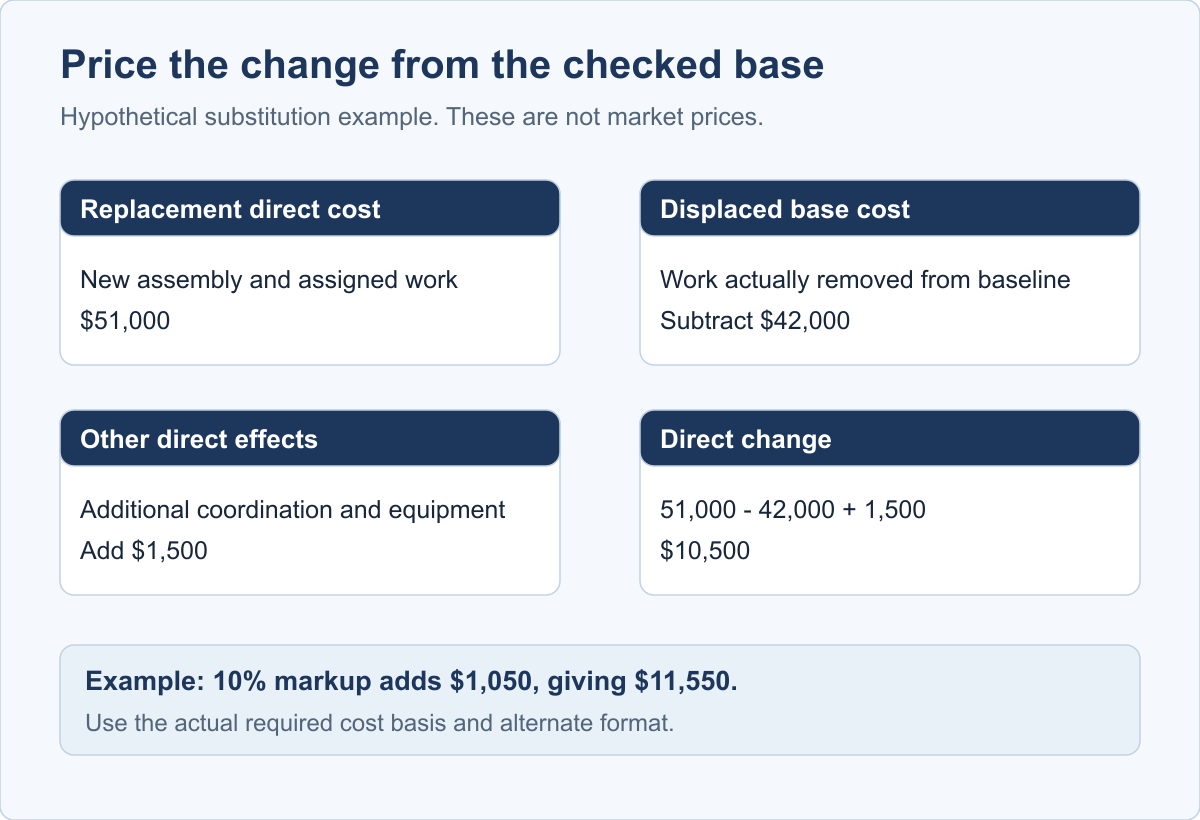
Assume an illustrative base assembly has $42,000 of direct costs that will actually be displaced. The alternate assembly requires $51,000, and the change creates $1,500 of additional coordination and equipment costs. The direct change is $51,000 − $42,000 + $1,500 = $10,500.
If this hypothetical estimate applies a 10% markup to that entire direct change, the addition is $1,050 and the resulting alternate is $11,550. The markup is an example input, not a recommended rate or a public-contract requirement.
Confirm the actual treatment of taxes, bonds, insurance, overhead, profit, and other adjustments under your estimating basis and the solicitation. Retain each component so the final amount can be checked without reverse-engineering a lump sum.
4. Test alternate combinations and dependencies
When the instructions allow or require combinations, check their combined scope. Two individually priced changes may affect the same base material, mobilization, control interface, or installation activity. Their simple sum may duplicate a credit or charge.
Record a combination adjustment only in the format the solicitation permits. Do not add an unsolicited condition to a bid form because your spreadsheet needs it. If a conflict affects the requested price, seek clarification through the authorized process.
Check deductive signs and labels carefully. A spreadsheet may store credits as negative values while the form asks for a positive amount in a deduction field. The reviewer should confirm the intended effect on the total, not only whether the copied digits match.
Keep internal selection scenarios separate from the submitted schedule. A scenario sheet helps review the arithmetic for permitted combinations, but it does not predict the owner's award decision or change its evaluation method.
5. Define the payable unit before building the rate
Read the item's measurement and payment language. Determine what the rate covers, how the quantity will be measured, and which related work is included elsewhere. A cubic-yard earthwork item may use a different measurement basis from a truck-volume supplier quote.
For unit-price site items, check excavation, haul, disposal, bedding, compaction, testing, restoration, and access where they relate to the defined work. Keep excluded or separately paid activities identified so the rate does not omit or duplicate them.
Confirm whether the schedule includes separate mobilization or other fixed-cost items. If a fixed cost must be carried within a unit rate, state internally how you allocated it and the quantity used. Follow the required pricing structure rather than choosing a new payment item yourself.
Review installation conditions and the expected quantity range. A small quantity spread across many visits can have a different cost basis from continuous production in one area. Price the stated work and conditions without assuming that every rate scales perfectly.
6. Build and check the unit-price extension
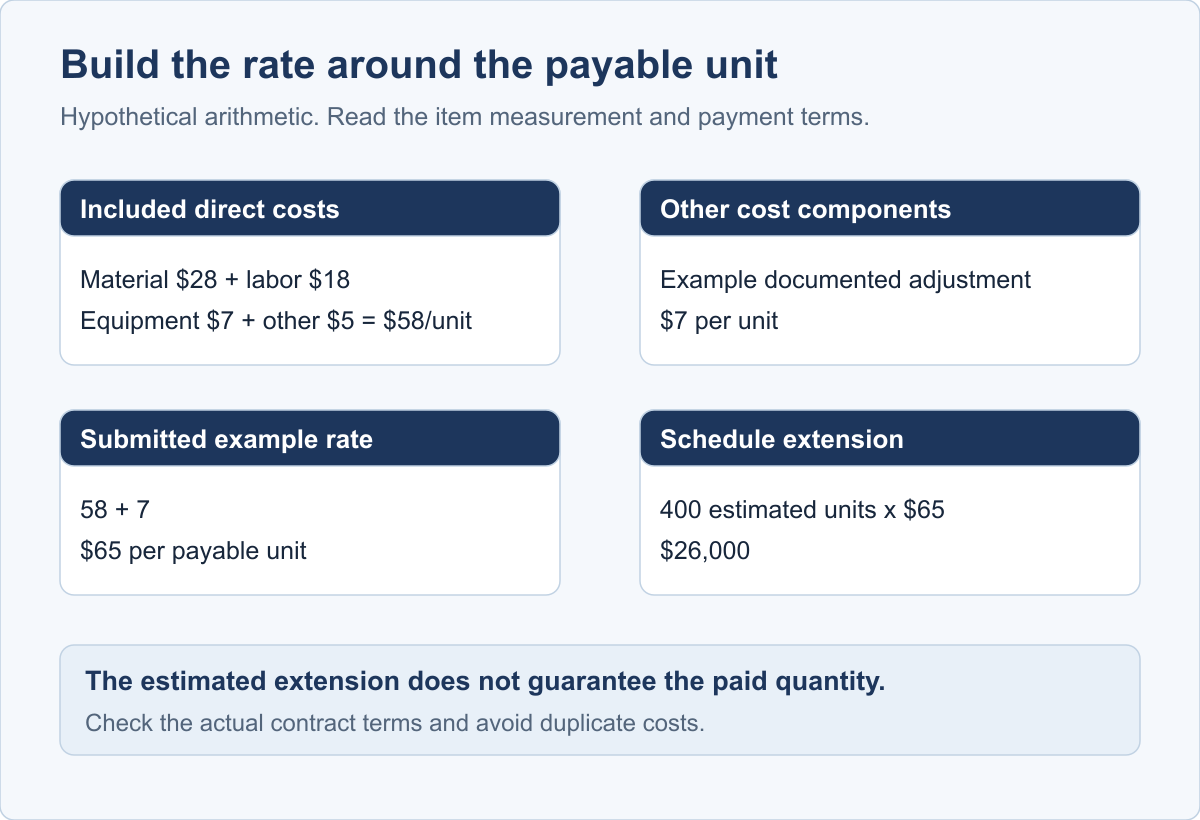
Consider a hypothetical unit item with $28 of material, $18 of labor, $7 of equipment, and $5 of other included direct costs per payable unit. The direct cost is $58 per unit. If the estimating basis adds $7 per unit for the applicable remaining cost components, the submitted example rate is $65.
At an estimated schedule quantity of 400 units, the extension is 400 × $65 = $26,000. That arithmetic does not establish the eventual payable quantity or entitlement to additional payment. The actual contract measurement and payment provisions determine those questions.
Confirm that the rate and extension use the same unit. Recheck conversions such as square feet to square yards, feet to meters, or nominal versus measured volumes where applicable. Keep the conversion calculation in the estimate and the requested unit on the bid form.
7. Review quantity variation and commercial assumptions
Read any clauses addressing changes in estimated quantities, fixed costs, or time. For example, FAR 52.211-18 sets out a specific variation mechanism for certain federal fixed-price construction contracts with estimated unit-priced quantities. Use it only where incorporated and applicable; other contracts can use different provisions.
Do not assume that a change in quantity automatically changes a rate, or that a published estimated quantity guarantees your production plan. Review the actual terms and escalate contractual questions to the responsible procurement or contract professional.
Internally, test how your rate behaves under plausible quantities and sequencing. That review can expose a fixed cost allocated over too many units or a labor basis that depends on uninterrupted access. Keep the submitted pricing compliant with the solicitation and avoid speculative rate loading.
8. Level subcontractor and supplier coverage
Request base and alternate breakdowns in the same scope format. Ask each bidder to identify what its change includes, what base work it removes, and whether it affects lead time or site attendance. Confirm which unit items its offer covers.
Compare the latest offers with your measured quantities and responsibility assignments. Equipment, testing, temporary work, and interface costs may remain outside a material supplier's price. Carry them in the appropriate package rather than assuming the lowest quoted change is complete.
Use a short exceptions log tied to the bid schedule. Resolve material scope gaps before selection and record the basis of any remaining estimate assumption. For a broader workflow, review how to price a completed quantity takeoff.
What should the final bid-form check cover?
Have a second reviewer trace each requested line from the current form to the estimate. Check descriptions, quantities, units, signs, decimal places, extensions, totals, and whether the required fields are complete. Review addenda for revised schedules or altered alternate descriptions.
Confirm that the base total does not already include an additive alternate and that a deductive item removes only the intended work. Reconcile submitted unit rates with their requested extensions and the estimate's cost summary.
Retain the issued bid form, submitted prices, selected quotations, document register, and calculation sheets together. Keep a clear final version so a later scope review or award discussion can refer to the actual submitted basis.
Conclusion
Price alternates from a checked base and build unit rates around the defined payable scope. Keep the changed work, quantity basis, and cost components visible, then review the form against the solicitation before submission.
BidAccurate's public construction estimating services can help organize base work, alternates, unit items, and supporting quantities. Share the current bid documents, addenda, schedules, and supplier offers so the estimate follows the requested package.
Frequently Asked Questions
Is an alternate always an extra cost?
No. It can add work, deduct work, or substitute a different system. Read the requested scope and pricing format, then calculate its effect against the stated baseline.
Should I price only the new material in a substitution?
Check the complete change. Include displaced base costs, new material and labor, accessories, equipment, and other affected activities. Avoid removing shared costs that remain necessary.
Can I assume the owner will select alternates in numerical order?
Use the solicitation's stated evaluation and award provisions. Public procurement methods vary, and an estimating scenario does not establish how the owner will choose or evaluate the work.
Does the bid quantity guarantee the paid quantity?
Read the contract's measurement and payment terms. A schedule can use estimated quantities, and the contract determines how actual work is measured and how any quantity variation is treated.
Should every unit price include mobilization?
Check the item definition and any separate mobilization provisions. Allocate costs using the required structure and avoid adding the same fixed cost in multiple places.
How should I check a deductive alternate?
Identify the work actually removed and the costs that remain. Verify the form's sign convention, related trade effects, and any combination rules before transferring the deduction.