
 12 min read





Key Takeaways
- Compare every supplier offer against the same equipment schedule, specification, drawing issue, and addenda.
- Keep technical deviations visible for the required review; an estimator should not select substitute ratings.
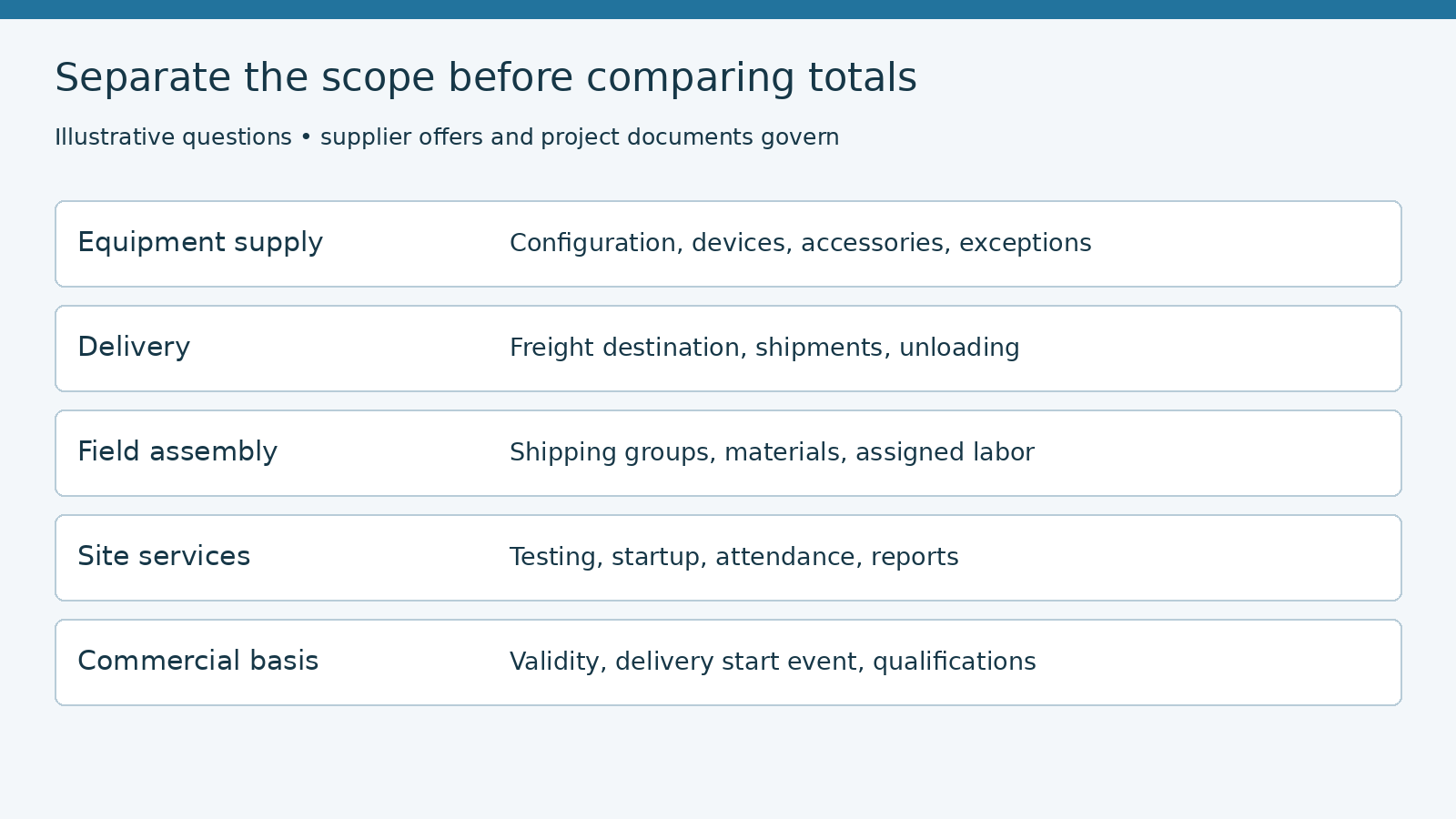
- Separate factory equipment supply from freight, unloading, shipping-split assembly, testing, and field attendance.
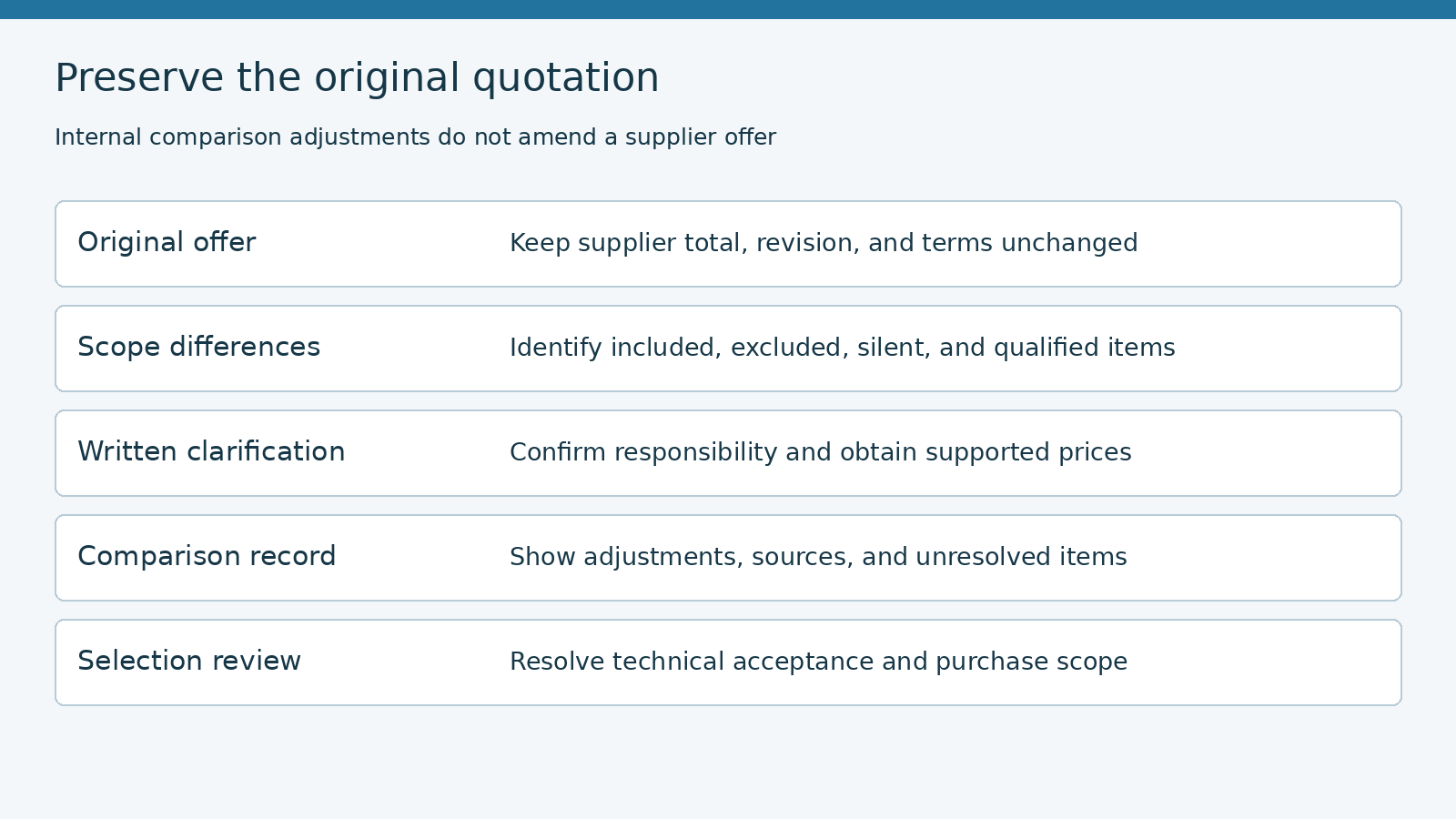
- Preserve original quotation totals and show supported comparison adjustments in separate columns.
- Record what starts the quoted delivery period, what is excluded, and which answers remain unresolved before bid submission.
Two switchgear quotes arrive before bid day. Both list the main equipment tag, but one includes freight and a startup visit while the other excludes both. The lower equipment total looks attractive until you discover that several site activities still need a price and an assigned contractor.
You need a comparison that follows the equipment from the issued design through delivery and the specified field work. Start with the original offers, identify what each supplier actually includes, and request written answers where the scope is unclear. That gives your electrical bid a traceable basis and helps the purchasing team understand what still needs agreement after award.
This review is for estimating and procurement scope. The project engineer and other authorized reviewers decide technical acceptance under the governing documents. Equipment operation, installation methods, and energized work require the applicable manufacturer instructions and qualified personnel.
Freeze the equipment and document basis first
Build a short quotation register before comparing totals. Record the supplier, quotation number, date, revision, validity period, equipment tags, and referenced drawing and specification issues. Add each addendum that changes the equipment or its interfaces. A quotation revised yesterday can still rely on an equipment schedule that was superseded last week.
Give suppliers the same requested scope. Include the one-line diagram, equipment schedule, relevant specification sections, installation details, and available site constraints. Ask each supplier to identify the documents used and list deviations. Preserve the original quotation and every later revision so a clarification does not erase the earlier pricing basis.
Use equipment tags as the first reconciliation point. Confirm that each offer includes all requested lineups, sections, associated devices, and separately listed accessories. Check whether an item is priced as a complete assembly, an optional addition, or a separate shipment. A matching tag alone does not prove that the offered configuration matches the design.
If you are still tracing the distribution scope, use the electrical one-line takeoff guide first. Quote leveling begins after you have identified the equipment package you intend to compare. Keep feeder quantities and other field work in their own estimate sections, with clear interfaces to the equipment package.
Compare the offered configuration without making design decisions
Create a compliance checklist from the actual project requirements. Record the specified equipment type, voltage, current ratings, interrupting or withstand requirements where applicable, enclosure, access arrangement, and other scheduled features. Copy the offered information beside the requirement and attach the supplier's exceptions.
Do not treat switchboards, switchgear, and different equipment constructions as interchangeable because a quotation uses a similar name. Ask the supplier to identify the offered product and its applicable documentation. Refer substitutions and technical differences through the project's required review process before relying on them as accepted scope.
Read the arrangement as well as the component list. Entry locations, connection provisions, section layout, and access can affect the field package. If an offer assumes a different arrangement, identify the related drawing and ask who must confirm compatibility. Avoid quietly pricing around a configuration that has not been accepted.
Keep every exception in the comparison even when the supplier says it is customary. A useful entry identifies the requirement, offered condition, responsible reviewer, and current disposition. Until there is a documented answer, classify it as unresolved. A blank cell should never be interpreted as compliance or inclusion.
Reconcile devices, accessories, and interfaces
Work through each scheduled assembly and its specified accessories. Depending on the project, the review can include metering, protective devices, control power, communications interfaces, spare devices, future provisions, and maintenance accessories. Your checklist should come from the issued documents and supplier package, rather than a generic list assumed to apply to every lineup.
Distinguish installed components from loose-shipped items. A supplier can furnish an accessory while leaving its installation or connection to the contractor. Record the furnishing party and the installing party separately. Also identify software, configuration information, or third-party coordination required for specified communications and controls.
Review utility and adjacent-equipment interfaces where the documents identify them. Confirm whether the quotation covers the required compartments, termination provisions, or transition assemblies. Send uncertain technical interfaces to the responsible reviewer. Do not infer utility acceptance from the manufacturer's product name or from a previous project's arrangement.
| Comparison item | Question for the supplier | Estimate follow-up |
|---|---|---|
| Metering and controls | Which scheduled devices and interfaces are included? | Identify separate integration or field wiring scope |
| Loose-shipped accessories | What ships separately, and who installs it? | Carry assigned labor and receiving checks |
| Future provisions | What is furnished now versus reserved for later? | Avoid counting an empty provision as supplied equipment |
| Connection assemblies | Which interfaces and materials are included? | Resolve gaps with adjoining packages |
Separate factory supply from shipping-split field work
Ask how the offered lineup will be shipped and what work remains at the site. The number of equipment sections and the number of shipping groups are different pieces of information. A lineup can require site joining between groups even when the supplier describes it as a complete equipment assembly.
Schneider Electric's HVLcc installation documentation identifies shipping-split field assembly and associated connections for that product. For estimating, use the exact offered equipment documents to identify activities that need scope ownership. This is not a universal installation sequence or labor allowance.
Request the anticipated shipping arrangement, available dimensions and weights, and the supplier's field-service scope. Confirm which joining materials are furnished, how they are identified, and which contractor carries assembly and connection labor. If those details depend on final drawings, record the assumption used in the bid and the information needed before release.
Keep handling and assembly separate from the equipment purchase line. The supplier may provide technical attendance without providing the crew, lifting equipment, access, or temporary services. Ask for a written description of what attendance includes and what preparation the contractor must complete before the representative arrives.
Review freight, unloading, storage, and site access
Read the delivery terms rather than assuming that freight included means equipment placed in its final location. Identify the delivery destination, unloading responsibility, shipping limitations, and any conditions attached to the freight allowance. Ask whether separate shipments or delivery appointments change the quoted scope.
Check the site's receiving plan with the construction team. Available access, temporary openings, equipment-room readiness, and the delivery sequence can affect the handling package. Use actual shipping information and a qualified handling plan to price the assigned work. The estimator should not invent weights or a lifting method from a generic photograph.
Eaton's medium-voltage switchgear receiving and installation booklet directs attention to the customer drawing package and equipment-specific information. It also addresses receiving and storage. Use the offered product's current requirements to identify protection, storage, and handling costs; requirements from one product should not be transferred to another without confirmation.
If the equipment may arrive before the room is ready, ask who carries storage and protection, where it will occur, and how long the bid assumes it will last. Include any separately assigned transport or return handling. Record the duration basis instead of hiding an open-ended storage obligation inside a lump-sum equipment price.
Define testing, startup, and attendance by activity
A line reading startup included needs a scope description. Ask what the supplier will do, how many visits or days are included, what notice is required, and which reports or records will be delivered. Identify any travel charges, return-visit conditions, or limits on the offered attendance.
Compare that offer with the project's specified field inspection, testing, commissioning, and training responsibilities. Some activities may belong to an independent testing agency, the installing contractor, the manufacturer, or another participant. Record the actual assignment and ensure the cost appears once. Supplier attendance does not automatically cover every activity required before acceptance.
List the preparation that other packages must complete before a visit. The estimate may need contractor labor for access, coordination, documentation, and attendance. Keep those costs visible even when the supplier's service itself is included. If the scope remains unclear, request clarification before using a zero adjustment in the comparison.
Avoid turning the quote review into technical test instructions. The required procedures, acceptance criteria, and authorization remain with the governing documents and responsible qualified parties. Your comparison needs to establish who provides the specified activity, what the offer includes, and what supporting price or assumption is used.
Compare delivery promises on the same starting point
Record the date of each supplier's delivery statement and the event that starts the quoted period. An estimate measured from receipt of an order cannot be compared directly with one measured from approved drawings or another release condition. Ask the supplier to identify the required approvals and information before manufacturing can proceed.
Separate submittal preparation, review, release, manufacturing, shipment, and arrival where the offer distinguishes them. Do not convert an estimated shipment date into a guaranteed delivery commitment. Keep supplier qualifications and unresolved dependencies beside the date so the project team can assess the actual schedule exposure.
If the project requires staged deliveries, ask whether the quote supports that sequence and whether it changes freight, storage, or service costs. Record any proposed acceleration as a separate option with its own scope and written supplier terms. No general market lead time can replace a dated statement for the actual offered equipment.
Check quote validity and commercial qualifications with the purchasing team. Payment milestones, taxes, cancellation provisions, escalation language, and warranty conditions can affect the comparison. Use the actual offer and contract review process; an internal leveling spreadsheet does not change those terms.
Build a comparison that preserves the original offers
Keep one column for the original supplier total and separate columns for comparison adjustments. Label each adjustment with its source, such as a written add price, a separate subcontract quotation, or a documented internal estimate. Show unresolved items as unresolved rather than assigning an unsupported amount.
For a fictional scope example, Offer A includes equipment and freight but excludes unloading and specified site testing. Offer B includes equipment, freight, and unloading, while testing remains unclear. You would seek a supported unloading price for A and a written testing answer for both. The example contains no market prices and does not establish which offer is preferable.
| Scope row | Offer A | Offer B | Action before comparison closes |
|---|---|---|---|
| Equipment configuration | Listed with exceptions | Listed without clear revision | Resolve exceptions and confirm common basis |
| Freight | Included | Included | Confirm destination and shipment assumptions |
| Unloading | Excluded | Included | Support A adjustment; confirm B limits |
| Specified site testing | Excluded | Not stated | Assign scope and obtain written pricing |
Use the same treatment for credits. If a supplier revises its scope, retain the revised offer as the commercial record and explain what changed. An estimator's comparison deduction is not a supplier-approved credit. Keep internal comparison totals clearly identified so they cannot be mistaken for a purchase order or an accepted offer.
Close the gaps before transferring the number into your bid
Review each open row with the people who own purchasing, installation, and technical review. Confirm that every required activity has an assigned package and a supported cost basis. Where an answer is still pending, record the bid assumption and any permitted qualification through the project's bidding procedure.
Reconcile the selected quotation revision with the final estimate. Remove superseded allowances only when the replacement scope is confirmed, and check that separately priced freight or services have not been counted twice. Review interfaces with feeder work, grounding, equipment foundations, and other assigned construction scope.
Pass the comparison and clarification trail to the purchasing team after award. They should see the original offer, accepted revisions, unresolved technical items, delivery basis, and field responsibilities. For broader package review, the mechanical bid checklist illustrates the same need to identify shared scope, although electrical equipment requirements remain project-specific.
Conclusion
A reliable switchgear quote comparison starts with a common document basis and keeps every scope difference visible. Review the offered configuration, identify delivery and field-work boundaries, and support adjustments with written information. Preserve the supplier's original commercial terms while the project team resolves technical acceptance.
If your team needs help connecting equipment quotations to the rest of the electrical package, discuss the drawings, quote revisions, and required breakdown with BidAccurate's electrical estimating team. A clear scope matrix gives the estimate and purchasing review the same starting point.
Frequently Asked Questions
What should I compare first in switchgear quotations?
Confirm the equipment tags, drawing and specification revisions, addenda, and offered configuration. Comparing totals before establishing that common basis can hide equipment differences and omitted scope.
Does freight included mean unloading is included?
Not automatically. Read the actual delivery terms and ask who unloads, receives, stores, and moves the equipment into place. Record those responsibilities separately in the estimate.
Who should review technical substitutions?
Use the project's designated technical review and approval process. The estimator should document the offered difference and its cost implications without treating a proposed substitute as accepted equipment.
Why do shipping splits affect the electrical bid?
Separate shipping groups can leave handling, joining, connections, and related field activities at the site. Confirm the exact product requirements and which materials, labor, and attendance each offer includes.
Is manufacturer startup the same as all required testing?
No. Compare the written startup scope with the project's inspection, testing, commissioning, training, and reporting requirements. Assign any remaining activities and contractor attendance to the correct package.
How should I record a missing price in the comparison?
Mark the item unresolved and request written clarification or a supported price. Keep any internal estimate separate from the original supplier offer, with its assumptions and source visible.