
 17 min read





Key Takeaways
- Compare subcontractor proposals against one defined drawing issue and scope breakdown.
- Preserve original offers and record included, excluded, silent, and qualified items separately.
- Request written clarifications before converting uncertain scope into comparison adjustments.
- Keep internal leveled totals distinct from subcontractor prices and agreed contract values.
- Review schedule, interfaces, and commercial conditions alongside the scope and cost comparison.
Three subcontractor proposals arrive for the same commercial project. One includes access equipment, another excludes it, and the third says nothing about it. The lowest total also carries a different drawing revision and assumes uninterrupted daytime access. Putting those three amounts in adjacent spreadsheet columns does not yet give you a useful comparison.
Bid leveling turns those differences into a traceable review. You preserve each offer, compare it with the same required scope, and document clarifications and supported adjustments. The result helps the project team understand what each option would require before selection and subcontract preparation.
The comparison must remain honest about uncertainty. An internal allowance for an excluded activity does not make that activity part of the subcontractor's offer. A low leveled total also does not establish that the bidder is suitable for the project. Scope, delivery, qualifications, and the actual commercial agreement still need their own review.
Define the comparison basis before entering prices
Identify the bid package, project areas, drawing revisions, specifications, addenda, and scope instructions used for the comparison. Record the issue date and any later clarifications. If bidders priced different information, ask them to identify the difference and provide an updated response where required.
Break the required work into items that a reviewer can verify. For a commercial interior package, that may include areas, assemblies, preparation, accessories, protection, access, cleanup, testing, and closeout responsibilities. Choose the breakdown from actual project requirements rather than copying a generic list without checking it.
Keep base scope, alternates, unit prices, and allowances in identifiable sections. If the project requires particular bid instructions or procurement procedures, follow them when requesting and evaluating responses. An internal comparison method must not silently replace the governing process.
Write a short basis statement at the top of the matrix. Include the document issue and major assumptions shared by the comparison. The statement gives later reviewers a way to understand what the totals represent without reconstructing the entire email history.
Preserve the original proposal and every revision
Save the submitted offer with its date, revision, attachments, and sender information. Record the original total exactly as supplied and retain any separate breakdown. Do not overwrite the original amount when you add an internal allowance or receive a clarification.
Give each response a proposal identifier. Link matrix comments to the relevant page, exclusion, email, or revised quotation. If a bidder changes its price, retain both the earlier and current offers and make clear which revision is under review.
Keep verbal discussions as open items until the necessary written confirmation arrives. Record the question, conversation date, and requested follow-up. A note that someone said an item was included may help your team remember the discussion, but it should not be treated as an agreed scope amendment without the required confirmation.
Separate arithmetic corrections from scope changes. If an extension or total appears inconsistent, ask the bidder to confirm its intended offer through the applicable process. Do not assume your spreadsheet's corrected number is the bidder's accepted price.
Build rows around work and responsibility
Use rows that describe a specific item and its boundary. Included painting is too broad if the actual question concerns substrate preparation, exposed structure, doors, touchup, or another defined surface. Identify enough detail for a bidder to answer without guessing which condition you mean.
Include location and document references where they help distinguish work. The same assembly on two floors may have different access or sequencing conditions. If one area is occupied during construction, keep that condition visible instead of assuming the bidder priced the same method everywhere.
Review interfaces between trades. Penetrations, patching, supports, temporary protection, controls connections, and other shared boundaries can disappear when every proposal refers to work by others. Assign the intended responsibility from the actual scope documents and ask each bidder to confirm its treatment.
Preserve the required deliverable or acceptance boundary. Supply-only material differs from a complete installed package. Factory testing differs from field attendance. A row should identify the actual responsibility needed so a yes response carries a defined meaning.
Use four scope states consistently
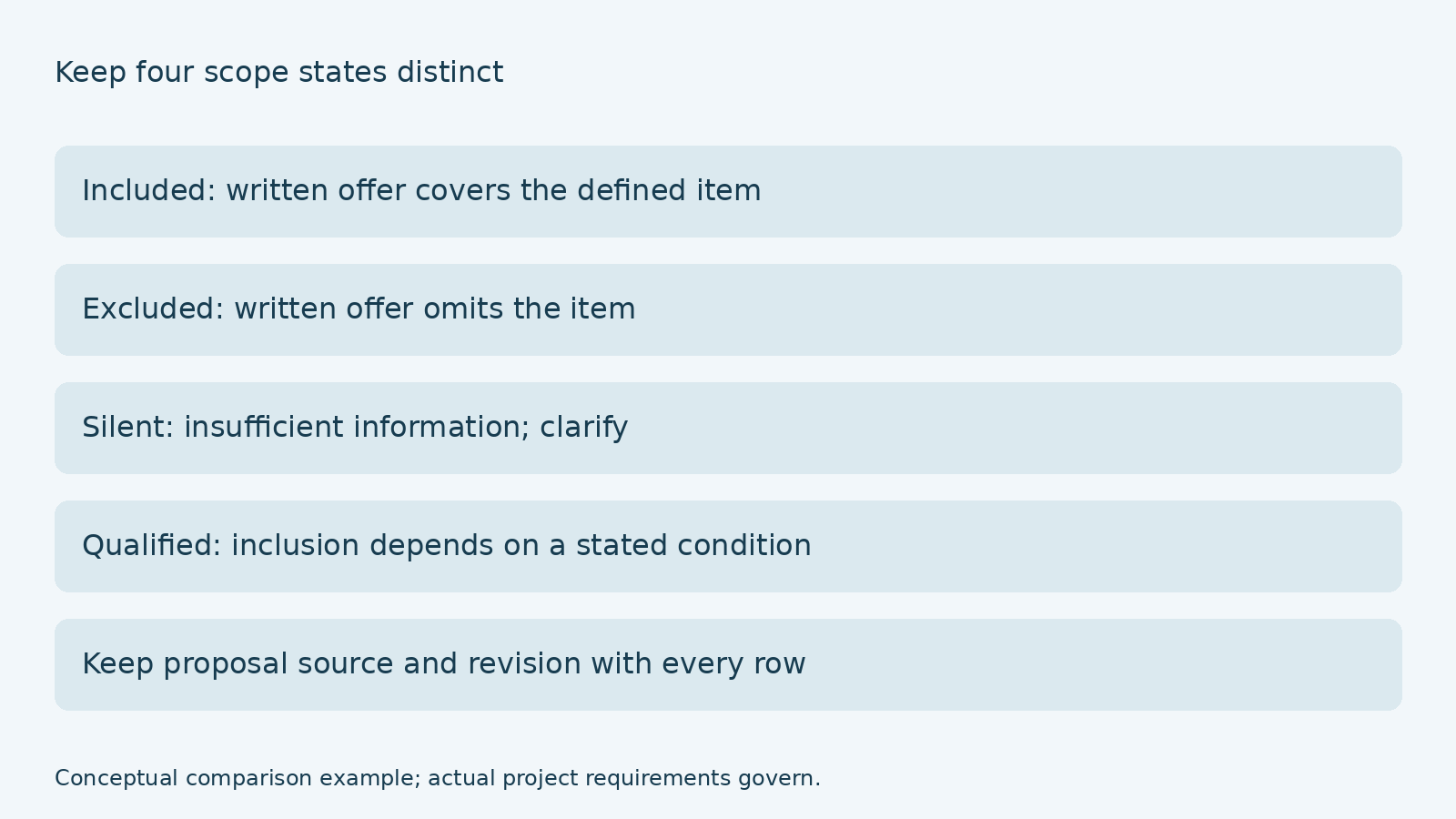
Classify each proposal line as included, excluded, silent, or qualified. Included means the written offer covers the defined item on its stated basis. Excluded means the offer expressly omits it. Silent means the response provides insufficient information. Qualified means the bidder's inclusion depends on a condition or differs from the requested scope.
Do not treat silence as a confirmed inclusion. Read the complete proposal and attachments, then request clarification if the item remains unclear. A blank cell can mean several things, including a missed response, a package assumption, or an item that the bidder considers outside its trade.
Keep qualifications readable. A bidder may include work only up to a quantity, only in a defined area, or only under a particular access assumption. Record the condition beside the row rather than reducing every answer to a color or check mark.
Use a legend and consistent terms across all bidders. Color can help scanning, but the written state and note should carry the information. A printed or exported comparison must remain understandable even when colors are lost or a reviewer uses a different display.
Request written clarification with a specific question
Send a question that names the row, location, document reference, and uncertainty. Ask whether the defined item is included in the stated offer and what price or condition changes if it is not. Avoid asking a bidder merely to confirm complete scope when the disputed boundary is much narrower.
For example, a fictional clarification could ask whether the proposal includes the specified access equipment for work in Area B under the issued phasing plan. Request the bidder's written treatment and any associated qualification. The question should seek its offer rather than telling it what number your internal comparison needs.
Record the response date and proposal revision it affects. If the answer changes the scope or price, obtain the appropriate revised offer or written confirmation. Keep unresolved questions in the register and identify how the team will treat them pending a response.
Apply the project's procurement rules and communication requirements. Different projects may restrict negotiations, post-bid changes, or information sharing. Keep questions focused on the required review and do not disclose another bidder's confidential pricing or use the matrix as permission to disregard those rules.
Use software features without losing the evidence
BuildingConnected's bid-leveling overview describes proposal columns, scope comparison, notes, and adjustments. Those features illustrate how a comparison can retain detail around the totals. The article does not establish what your contract requires or prove that an internal adjustment has changed a bidder's offer.
Procore's bid-leveling guidance describes reviewing submitted bids, identifying missing or excluded items, adding notes, and viewing field activity. The underlying review still depends on accurate documents and clear decisions, regardless of the software used.
If you work in a spreadsheet, preserve the same evidence trail with protected original-offer fields, separate adjustment columns, source references, and revision notes. Choose controls appropriate to the team. A complex workbook can become harder to review if formulas or hidden rows obscure the comparison basis.
Export a review copy when decisions are made and retain the working version according to the project's records process. Record the date and current proposal revisions. A live screen can change after a meeting, so the decision record should identify the information actually reviewed.
Support each comparison adjustment
An internal adjustment estimates the cost consequence of a scope difference for comparison. Give it a clear description, sign, source, and status. Distinguish a confirmed separate quotation from a preliminary estimating allowance and from an unresolved item with no supported amount.
Use actual quantities and relevant resource information when an adjustment needs a build-up. Keep material, labor, equipment, and other components identifiable at a useful level. If you use another subcontractor's quotation for a separate activity, check that its boundaries match the gap being filled.
Avoid double counting. A bidder may already include an accessory in another line, or a general contractor's estimate may already carry the excluded activity. Trace the responsibility and cost location before adding an allowance to the comparison and again to the overall project budget.
Do not use an unsupported number solely to force all bidders onto a preferred ranking. If the amount remains uncertain, show the uncertainty and request better information. A comparison can identify a decision that is not ready rather than presenting a precise-looking total with no reliable basis.
Work through a fictional three-bid comparison
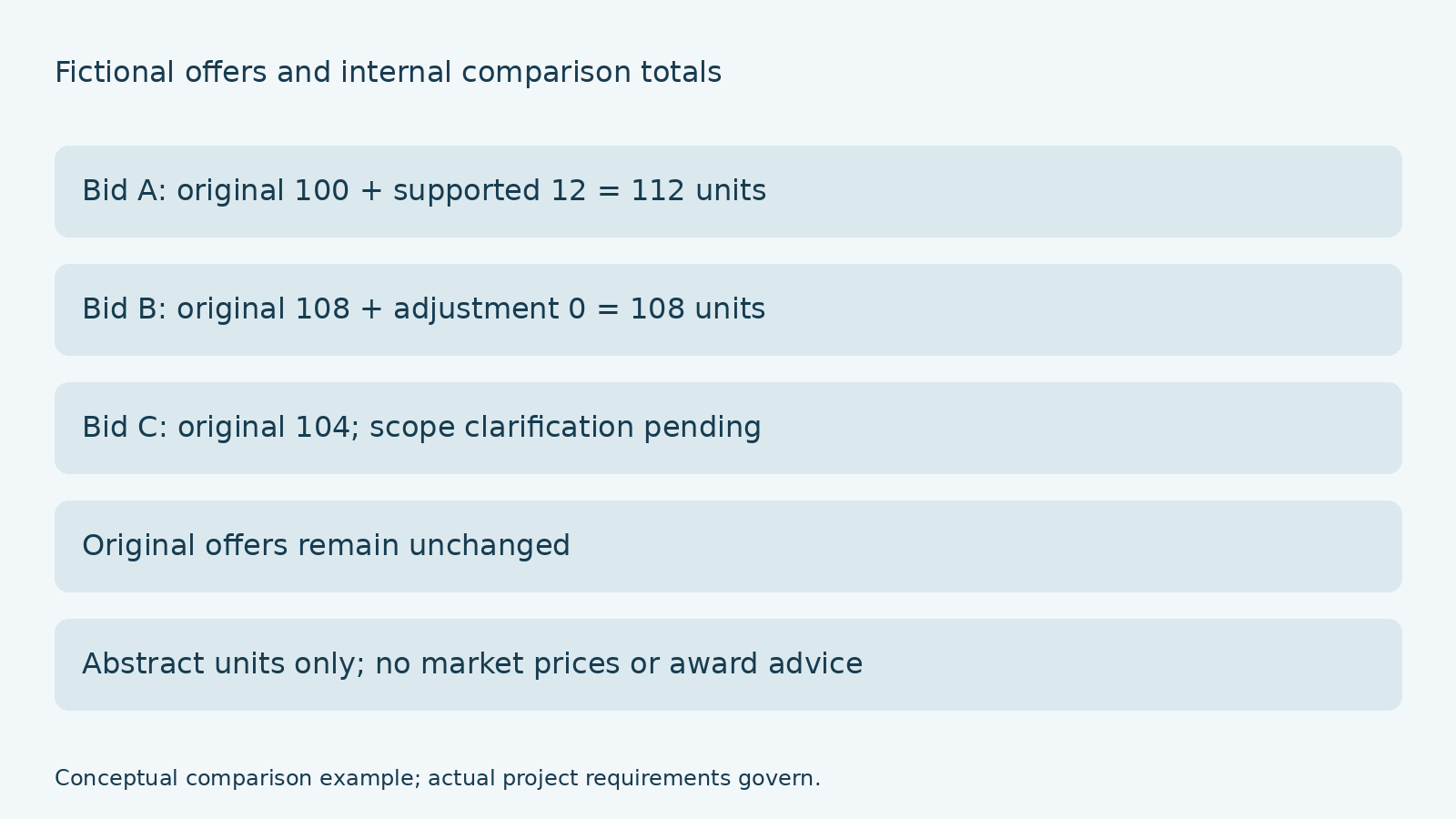
Assume a fictional package has three offers expressed in abstract cost units. Bid A is 100 units and excludes a defined access activity. Bid B is 108 units and confirms that activity is included. Bid C is 104 units but is silent about it. These are arithmetic examples, not market prices, quotations, or recommendations about real subcontractors.
Suppose the team has a separately supported 12-unit estimate for the exact activity excluded by Bid A. Its internal comparison total becomes 112 units. The original offer remains 100. Bid B remains 108 on the defined basis. Bid C needs clarification before the team can treat its 104 units as comparable.
| Fictional bidder | Original offer | Access activity | Internal adjustment | Comparison total |
|---|---|---|---|---|
| A | 100 units | Excluded | 12 supported units | 112 units |
| B | 108 units | Included | 0 | 108 units |
| C | 104 units | Silent | Pending clarification | Not established |
The comparison reveals why the original low offer may not represent the lowest cost to complete the defined scope. It does not automatically select Bid B. The team still needs to review each bidder's delivery commitments, qualifications, exclusions elsewhere in the offer, and the applicable selection process.
If Bid C later confirms the activity is included, retain that written response and update the status. If it issues a revised price, preserve the prior 104-unit offer and identify the new revision. Do not silently change the original column to make the table look cleaner.
Review alternatives and allowances separately
Keep a base-scope comparison before evaluating alternate combinations. An alternate may add or delete work, substitute a product, or change a sequence. Identify which base items it replaces and whether related accessories, labor, and commercial conditions change with it.
Use the same alternate definition across bidders. A price labeled alternate one in one proposal may describe a different boundary from the bid form. Confirm the scope and sign before combining it with a base offer. A deduct alternate should not be applied twice through both a revised base and a separate subtraction.
For allowances, identify what the amount covers and what remains outside it. Separate supply value, installation, handling, tax treatment, or other components according to the actual documents. Equal allowance amounts do not prove that the surrounding scope is equal.
The bid-alternate and unit-price guide addresses those items in their bidding context. Carry the actual project instructions into the leveling matrix rather than assuming a generic alternate practice applies to every procurement.
Check schedule and site assumptions alongside price
Read the offered start conditions, durations, working hours, phasing, and access requirements. A subcontractor may price continuous work while the project requires several separated visits. Identify that difference and request confirmation of the scope and commercial effect.
Keep delivery statements dated and tied to the specified or offered products. Ask what information or approval starts the quoted period. A proposed product substitution may change technical review and procurement assumptions, so route it through the responsible process before treating it as equivalent.
Review occupied-area restrictions, protection, storage, unloading, hoisting, utilities, and cleanup boundaries. Confirm who provides each shared resource and where its cost sits in the overall estimate. An exclusion can be acceptable when another defined package covers it, but that responsibility must remain visible.
Do not convert a qualified statement into a guarantee. If a bidder conditions its program on approved submittals or unrestricted access, preserve the condition. The team can then decide whether the project can meet it or whether the offer requires further revision.
Compare commercial terms on their actual basis
Review the terms that affect the offered scope and price, including quotation validity, payment assumptions, bonds, insurance, taxes, freight, escalation qualifications, and other project-relevant conditions. Use the contract and procurement requirements to determine which differences need resolution.
Keep technical acceptance separate from commercial comparison. A cheaper substituted product may need professional review and approval. An internal cost allowance does not establish that the product meets the specification or that the bidder has agreed to supply the specified alternative at that amount.
Document unresolved terms with a responsible reviewer. Some conditions require input from project management, procurement, insurance, or legal personnel. The estimator's matrix should make the issue visible without pretending to resolve rights or obligations through a spreadsheet note.
Before selection, reconcile the proposed agreement with the current offer and clarifications. The scope exhibit should not refer to an obsolete quotation or omit a qualification that the team still needs to address. Use the project's authorized contracting process to establish the final arrangement.
Handle partial bids and scope gaps carefully
A partial bid can still be useful when its boundary is clear. Identify the included areas or activities and compare it with a corresponding portion of other offers. Do not place a supply-only amount beside a complete installation package without showing the missing responsibilities.
If two partial offers will be combined, check their interface directly. Delivery, unloading, storage, layout, installation accessories, testing, and closeout can fall between suppliers. Add each responsibility to the matrix and identify the party expected to carry it.
Keep an unpriced gap visible rather than hiding it in a general contingency. A project-level contingency and a known omitted scope item serve different estimating purposes. If the team uses a temporary allowance, label the amount, basis, and action needed to replace it.
Review exclusions that shift risk beyond the trade boundary. An offer may exclude all work affected by existing conditions or require another contractor to prepare a substrate to an undefined standard. Ask for a clear boundary and route unresolved contractual treatment to the responsible reviewer.
Use sensitivity checks when information remains uncertain
When a comparison depends on an unresolved allowance, test how that item affects the decision without presenting the test as a new quotation. Identify the uncertain input, a supported range or alternative scenario where available, and the resulting comparison totals.
In the fictional example, Bid A's original 100 units plus an access adjustment exceeds Bid B's 108 units when the adjustment is greater than eight. At an eight-unit adjustment, both comparison totals are 108. This arithmetic identifies the amount that needs reliable support; it does not determine the actual access cost.
If no defensible range exists, say so and prioritize clarification. Adding a wide invented range gives an appearance of analysis without improving the evidence. Use sensitivity work to focus review effort on the assumptions that can change the result.
Record the decision criteria beyond the total. The team may need to consider scope completeness, ability to meet the program, relevant experience, resources, and other documented project requirements. Avoid inventing a numerical score unless the project actually defines and supports that evaluation method.
Review the matrix before making a recommendation
Ask a second reviewer to trace one included item, one exclusion, and one adjustment back to the original records. Check that the quoted total matches the submitted offer and that every adjustment has a source. Review signs, formulas, hidden rows, and selected alternate settings.
Compare the matrix with the overall estimate. Confirm that an item carried by the general contractor is not also added as a subcontractor comparison adjustment without explanation. Reconcile temporary resources and shared activities across all packages rather than reviewing each trade in isolation.
List open questions in the recommendation. Separate issues resolved by written clarification from assumptions accepted internally and issues still requiring an agreement. A concise recommendation can identify a preferred option while making the conditions for proceeding explicit.
Retain the review date, participants or responsible reviewers as appropriate, proposal revisions, and the decision record. Do not imply that an apparent low bid has been awarded merely because it appears first in a software view. Selection and contract authorization follow the actual project process.
Transfer the agreed scope into purchasing and delivery
After selection through the required process, carry the current scope and accepted clarifications into the purchase or subcontract package. Preserve the document references and boundaries used in the decision. Internal notes that never reach the agreement can leave the field team expecting work the supplier did not accept.
Identify assumptions that depend on later information, such as final layouts or phased release dates. Assign responsibility for closing them and keep the resulting changes traceable. The change-order estimate guide explains a separate workflow for documenting later scope changes and supported adds and credits.
Archive the original offers, comparison version, clarifications, and final scope record together. If the project team later reviews a gap or disputed boundary, those records show what was offered, what was assumed, and what was ultimately agreed.
Use lessons from the review to improve the next bid form. Repeated silence around access, testing, or closeout can indicate that the request did not define those responsibilities clearly. Improve the question and scope references instead of relying on another unexplained allowance in the next comparison.
Conclusion
A useful bid-leveling matrix preserves original offers while exposing the differences that affect completion of the required work. Define one basis, classify scope consistently, obtain written clarifications, and support each adjustment. Review schedule and commercial conditions before transferring the agreed scope into the contract package.
For help organizing quantities and comparison backup for a commercial project, share the issued documents, scope instructions, and received proposals with BidAccurate's commercial construction estimating team. Agree on the deliverable and responsible decision-makers before the review begins.
Frequently Asked Questions
What is construction bid leveling?
It is the organized comparison of proposals against a defined scope and document basis. The review identifies differences, obtains clarifications, and records supported internal adjustments without rewriting original offers.
Should I assume a silent item is included?
No. Read the full proposal and request clarification when the required item remains unclear. Keep silent items distinct from confirmed inclusions and exclusions until the evidence supports a change.
Does a leveled total change the subcontractor's price?
An internal comparison adjustment does not amend the offer. Obtain the required revised quotation or agreement through the project's authorized process before treating the adjusted scope or price as accepted.
Should the lowest leveled bidder always be selected?
No. Review the actual selection requirements, scope completeness, schedule, qualifications, resources, and unresolved conditions. A comparison total supports that decision but does not replace it.
How should alternates be compared?
Preserve a base-scope comparison and identify exactly what each alternate changes. Check the same definition, sign, and related work across bidders before applying any combination.
What supports a leveling adjustment?
Use a traceable quotation, quantity and resource build-up, or another documented estimating basis. Label preliminary allowances and unresolved items clearly and check for duplicate coverage elsewhere.
Can bid-leveling software replace scope review?
No. Software can organize offers, notes, and adjustments, but the team must verify the documents, interpret boundaries, obtain clarifications, and establish the final agreement.