 17 min read




Key Takeaways
- Trace the actual enclosure route by construction phase, then separate straight fencing from vehicle and pedestrian gate openings.
- Convert each uninterrupted run using the selected system's usable panel coverage. Confirm corners, terminations, bases, and gate hardware with the supplier.
- Price rental quantity and rental duration separately, including installation, relocations, delivery, removal, and the agreed off-rent process.
- Keep screens, support requirements, existing fence repairs, and site preparation visible as distinct scope items.
- Compare offers against the same layout and billing assumptions; a lower monthly rate can still produce a higher complete project cost.
You measured the site perimeter and requested a fence quote. The supplier's number looks reasonable until the superintendent asks for a second gate, the paving crew needs the south run moved, and the rental continues while the owner finishes its inspection. Your original linear footage is still correct, but it no longer explains the cost.
A temporary fence estimate needs a layout and a time basis. You have to know what stays on site, when it arrives, how it changes, and what must happen before billing ends. Those details let you compare supplier proposals and give the project team a scope it can manage.
Start with the issued site logistics plan, specifications, phasing information, and actual rental terms. The examples here use fictional dimensions and billing assumptions to explain estimating arithmetic. They do not establish a compliant fence layout, support design, or supplier rate.
1. Define the enclosure before measuring the property
The property boundary and the temporary enclosure can follow different routes. A contractor may need room for a sidewalk, a material delivery area, an occupied entrance, or work that extends beyond the main building footprint. Trace the enclosure shown in the current logistics documents and identify the revision you measured.
Give every run a location code. North frontage, loading area return, and east utility corridor are more useful than a single total with no markup. Record the drawing sheet, measured length, fence type, phase, and any unresolved boundary question beside each code.
Check whether an existing permanent fence can form part of the enclosure. Confirm its condition, required height, gate availability, and permission to use it. Keep any repair or temporary tie-in separate. Counting an existing fence as usable without review can leave the rental package short; renting a parallel run unnecessarily can overstate it.
Read the general requirements and subcontract scope assignments together. The general contractor, demolition subcontractor, and sitework contractor may each assume another party supplies the enclosure. Identify who carries rental, installation, routine attention, gate operation, and removal. Obtain a written clarification when the documents leave a gap.
BidAccurate's sitework estimating services include temporary fence when requested. Send the logistics and phasing information with the civil set so the takeoff can show this scope separately from grading, utilities, and permanent site improvements.
2. Identify the specified fence system and its limits
Temporary panel fencing and fencing with driven posts require different quantity schedules. Panels have discrete coverage and compatible stands or bases. A driven-post system needs its specified posts, fabric, connections, and installation method. Confirm which system the bid requires before converting footage into components.
National Rent-A-Fence's product guidance distinguishes in-ground chain-link fencing from panel fencing and lists screens and swing or sliding gates as options. That distinction helps define the request for pricing; the selected supplier still needs to confirm the assembly for your site.
Do not copy nominal dimensions from an unrelated catalog into the estimate. A product described as six feet high by twelve feet long is different from an eight-foot-long panel. Confirm the usable installed coverage, connection arrangement, and any required end adjustment. A supplier may quote installed linear feet even when its internal delivery schedule counts panels.
Record fence height independently from length. If only a frontage requires a different assembly or height, separate that run. Keep solid hoarding, pedestrian barricades, and vehicle barriers on their own lines when specified. A chain-link fence quantity does not describe impact protection or replace a separately required traffic barrier.
For driven posts, flag underground utilities, pavement penetrations, and surface restoration for the responsible team and supplier to review. For freestanding panels, identify surface changes and restricted space for supports. These conditions affect pricing and feasibility; your estimating worksheet should not invent post embedment or ballast requirements.
3. Measure straight runs and gate openings separately
Measure along the intended fence line, including returns around obstacles. Follow each change of direction instead of scaling a straight shortcut across a corner. Check drawing scale against a known dimension, and use field information where the project requires confirmation of existing conditions.
Assign each gate an identifier and record its location, required clear opening, proposed operation, and duration. A vehicle gate can have one leaf, two leaves, or a sliding arrangement. The clear opening needed for access and the overall assembly dimension are separate inputs. Ask the supplier to reconcile them.
Deduct the designated opening from straight fencing once, then carry the gate assembly separately. If the supplier quotes a complete installed perimeter including gates, explain your measurement basis and request a breakdown. Otherwise, one offer may include gate frontage in its footage while another excludes it.
Gate positioning can split a long run into smaller sections. Preserve those sections when converting to panels, because a remainder on one side of a gate cannot automatically cover a remainder elsewhere. Check gate posts, hinges, latches, wheels or tracks where applicable, locks, and any specified access-control items as part of the supplier package.
Ask the superintendent to review delivery access, turning space, gate movement, and the planned pedestrian route. Route adequacy, emergency access, accessibility, and local approval requirements belong with the responsible project team and authority. An estimator can identify an unanswered requirement and carry its cost basis without declaring the layout approved.
4. Work through a perimeter and panel example
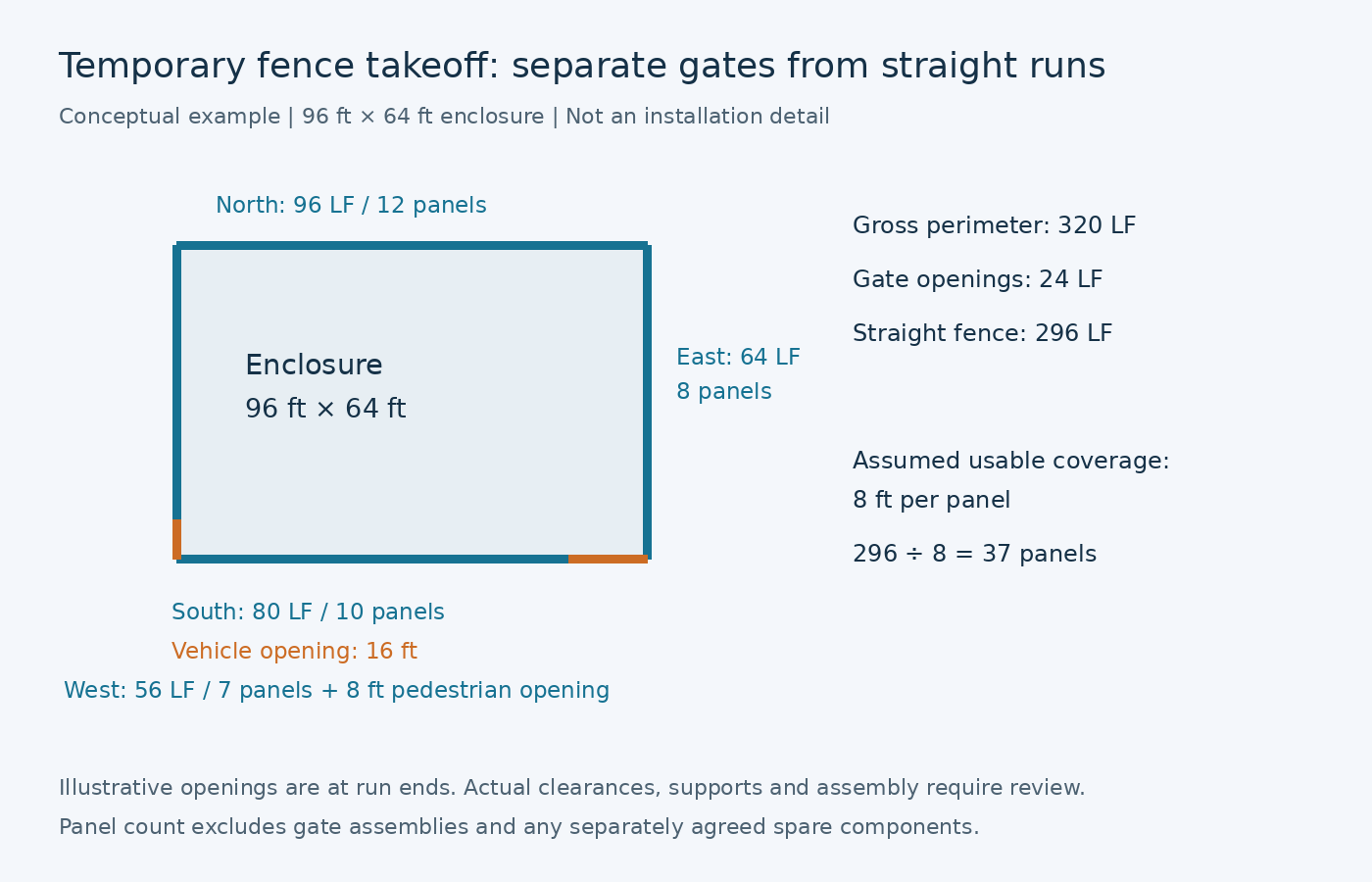
Assume a fictional rectangular enclosure measures 96 feet by 64 feet. It has a 16-foot vehicle opening on the south side and an 8-foot pedestrian opening on the west side. For arithmetic only, assume the selected system provides exactly 8 feet of usable coverage per straight panel and the supplier accepts the resulting arrangement.
The gross enclosure length is 2 × (96 + 64) = 320 linear feet. Gate openings total 16 + 8 = 24 linear feet. Straight fencing therefore measures 320 − 24 = 296 linear feet. The gates remain separate assemblies; their openings have not disappeared from the enclosure.
| Run | Gross side length | Gate deduction | Net straight fencing | Assumed 8-foot panels |
|---|---|---|---|---|
| North | 96 LF | 0 LF | 96 LF | 12 EA |
| South | 96 LF | 16 LF | 80 LF | 10 EA |
| East | 64 LF | 0 LF | 64 LF | 8 EA |
| West | 64 LF | 8 LF | 56 LF | 7 EA |
| Total | 320 LF | 24 LF | 296 LF | 37 EA |
This simplified example places both openings at the ends of their respective straight runs. If a gate moves into the middle of a side, recalculate its two remaining segments. The total footage can remain unchanged while the component arrangement changes.
When an uninterrupted segment is 65 feet and the assumed usable panel length is 8 feet, division gives 8.125 panels. Nine full panels provide 72 feet of nominal coverage. That arithmetic identifies a layout question; it does not authorize cutting a rental panel, leaving a gap, or overlapping panels in a way the system does not permit.
Ask the supplier how it will resolve the remainder using its approved configuration. Keep the measured 65 feet and the proposed component count in separate columns. A confirmed spare panel is also a separate allowance. Do not bury a general waste percentage in measured fence length and then add spare panels again.
5. Schedule accessories without guessing support requirements
A panel count alone cannot establish the number of bases, clamps, braces, or weights. Shared connections, free ends, corners, and gate interfaces can change the assembly. Request the supplier's component schedule against your marked layout, then reconcile its count with each location.
United Rentals' temporary fencing catalog lists fence panels, pedestrian and vehicle gate products, stabilizers, and base weights. Carry the required assembly items explicitly instead of assuming the fence rental rate includes every accessory.
Privacy screen needs its own quantity and specification. Identify which runs receive it, the required height or coverage, attachment requirements, and whether it is rented or purchased. Do not add screen to every panel merely because the street frontage needs screening.
Screening changes how wind acts on an enclosure. Refer its support implications to the supplier and responsible designer where required. Obtain the applicable configuration and pricing before finalizing the estimate. A generic ballast allowance cannot demonstrate stability, and a supplier catalog description does not establish suitability for every exposure.
Keep signs and access accessories visible too. Record project-required identification signs, locks, gate keys, and any lighting or powered access equipment with the party responsible for supply. Confirm whether attachments are permitted on rented components. Separate an optional branded screen from a mandatory project requirement so the comparison remains clear.
6. Build the rental duration from project milestones
The construction schedule provides a starting point, but fencing may arrive before major field work and stay after the last trade leaves. Identify the earliest date the enclosure is needed, the expected installation date, phase changes, and the condition that allows final removal.
Ask what starts and stops rental billing. Delivery, dispatch, completed installation, an off-rent request, physical collection, or a contract-specific event can affect the charged period. Keep those definitions beside the estimate's assumed dates. A planned removal date has little value if the project team does not know the required notice process.
United Rentals' US rental terms, for example, address charge commencement, off-rent notification and confirmation, pickup, and separate transportation charges. Read the terms incorporated into the actual fence proposal. Do not apply one supplier's general agreement to every rental package.
Use calendar duration when the applicable agreement charges for equipment remaining on site through weekends and holidays. Labor workdays and rental days serve different purposes. A five-day installation workweek does not automatically mean the fence rents for only five days each week.
For a fictional offer that bills whole 30-day periods without prorating, 90 chargeable days require three periods. Ninety-four days require four. Those are illustrative commercial terms, not a claim about standard industry billing. Another supplier's four-week, daily, or prorated basis must be calculated according to its own written offer.
Label uncertainty as a schedule assumption. If final removal depends on an inspection, obtain the project team's expected release date and test a reasonable extension scenario. Show the extra period and related services separately so the reviewer can decide how to carry that exposure.
7. Separate rental exposure from installation and moves
Build a phase register when the enclosure changes. Record panels and gates needed in each phase, the length moved, the components returned, and any overlap while the new boundary is established. A peak inventory count helps the supplier reserve equipment; a duration schedule explains how long each quantity stays on rent.
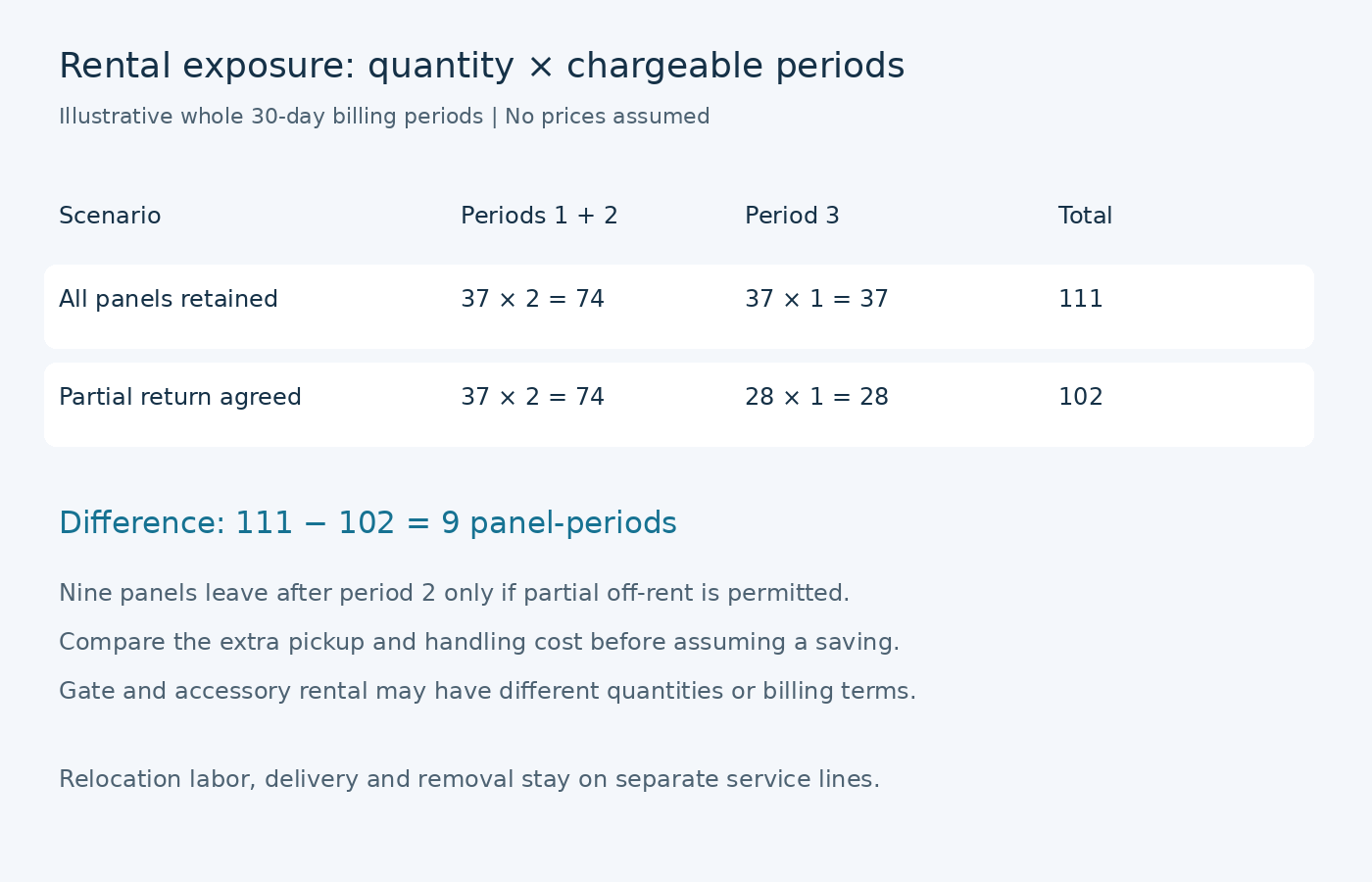
Suppose the fictional 37 panels stay on site for two 30-day periods, then nine panels are returned and 28 remain for one more period. If the agreement permits that partial off-rent arrangement, panel rental exposure is (37 × 2) + (28 × 1) = 102 panel-periods. Keeping all 37 for three periods would produce 111 panel-periods.
The nine-panel-period difference does not establish a saving by itself. Ask about pickup charges, minimum retained quantities, return conditions, and the cost of the extra visit. A supplier may offer a lump sum for the package instead of billing each panel. Apply the actual quote structure before drawing a cost conclusion.
A relocation usually includes work even when the same panels remain on rent. Identify dismantling, handling, temporary storage, resetting, revised supports, and supplier travel as applicable. Also ask whether a second enclosure must be installed before the first is removed. That overlap can temporarily increase the number of rented components.
Where demolition affects the enclosure route, coordinate the move with retained areas and access restrictions. The selective demolition estimating guide explains why access and protection need separate scope review. Keep fencing relocations in one responsible package so both trades do not carry the same move.
8. Request a complete supplier scope
Issue the same marked layout and quantity register to each supplier. Include location, intended dates, fence and gate descriptions, screen locations, surface conditions, and planned moves. Ask each bidder to identify substitutions and exclusions rather than returning an unexplained total.
| Cost element | Information to request | Estimate treatment |
|---|---|---|
| Fence and gate rental | Included quantity, assembly, rate unit, minimum term | Apply the quoted quantity and duration basis |
| Delivery and installation | Trips, unloading, site access, included labor | Separate from recurring rental unless expressly bundled |
| Accessories and screens | Included items, support configuration, rental or sale | Avoid adding a second allowance for included items |
| Relocations | Move scope, callout terms, handling, additional inventory | Carry each planned phase change |
| Removal and off-rent | Notice, confirmation, pickup, access and return conditions | Connect billing termination to an assigned action |
| Other charges | Applicable taxes, fees, damage terms and exclusions | Show the actual applicable basis separately |
Review site preparation before delivery. Debris along the fence line, stored materials, uneven ground, parked vehicles, or restricted unloading can prevent the planned installation. Assign clearing and access preparation to the responsible party. If the supplier excludes that work, obtain a project-supported allowance or qualification.
Confirm whether the quote includes normal maintenance, adjustments after other trades disturb the line, or emergency callouts. Ask who inspects and operates gates, who reports damage, and who can authorize a service visit. These responsibilities affect the project budget even when their cost sits outside the fence subcontract.
Check loss and damage provisions, return inspection, and any optional protection product against the actual agreement. Avoid assuming ordinary rental includes replacement of missing parts. Preserve the quoted terms in the estimate backup so the project manager can review them before ordering.
9. Compare offers on the same basis
Retain each supplier's original total and qualifications. Then build a separate comparison that uses the same enclosure, gate configuration, rental dates, and move assumptions. A price for panels delivered to the curb cannot be compared directly with a complete installed and removed package.
For each difference, request written clarification first. Mark an item included, excluded, or unanswered. Use a supported comparison adjustment only when you have a basis for its value. An internal estimate of omitted installation does not amend the supplier's offer or prove it will perform the work for that amount.
Check extension rates as carefully as the initial term. A proposal can look favorable for the planned duration and become less attractive when the project needs another billing period. Compare the base program and one clearly labeled extension scenario using each offer's actual terms.
The construction bid leveling workflow provides a broader method for preserving offers while documenting scope adjustments. For temporary fencing, keep rental periods, gate assemblies, and service visits visible throughout that comparison.
A useful cost structure is recurring rental plus agreed one-time services plus applicable charges and separately identified risk allowances. Fill that structure with current supplier quotations and project information. A generic national price per foot cannot account for your gate arrangement, rental term, access, and relocation plan.
10. Review difficult boundaries and common errors
Shared boundaries need an explicit scope decision. If adjacent contractors use one enclosure, confirm who pays, who can move it, and when either party may remove it. Do not deduct another contractor's fence solely because it appears on a neighboring logistics drawing.
Occupied sites require particular attention to changing access. A route that works during demolition may block a tenant entrance during fit-out. List the affected phase and seek the responsible team's approved arrangement. Carry the resulting gate or relocation scope after that decision, with its own duration.
Sloping ground can make plan length insufficient for component selection. Keep the measured route and flag grade transitions for supplier review. Do not assume every rigid panel can follow the slope without gaps or a changed arrangement. Record field verification as an outstanding item when elevation information is missing.
Another common error is treating purchased screen and rented panels as one repeating charge. Confirm the commercial basis for each component. A purchased item may still need installation and later removal, while a rented accessory may remain chargeable until it is returned.
Finally, reconcile the gate deduction after revisions. When a new opening is added, update straight footage, components, gate hardware, supports, and the supplier request together. Keep the superseded layout in the backup, clearly marked, so nobody orders from the earlier count.
11. Hand over an estimate the field team can close out
Package the final layout, revision reference, run schedule, gate register, supplier clarification, and rental dates with the estimate. Identify every remaining assumption and the person responsible for resolving it. Separate measured quantities from supplier component counts and commercial allowances.
Before delivery, confirm the order matches the selected quote and the current site layout. At installation, reconcile delivered components and note discrepancies through the project's normal receiving process. Photographs and delivery records can help establish what arrived and where it was installed without replacing a proper component count.
Assign the off-rent action before the project reaches closeout. Record required notice, authorized contact, confirmation reference, removal date, and returned quantities. Review the final invoice against those records and the agreement. An estimate that includes removal but gives nobody responsibility for requesting it leaves a preventable cost unresolved.
Conclusion
Estimate temporary fencing from a defined enclosure and a defined rental period. Separate gate openings, confirm the supplier's component arrangement, and carry installation and phase changes explicitly. Use the same assumptions to compare offers and hand over the off-rent requirements with the budget.
For help organizing the site quantities, send your current civil drawings, logistics plan, phasing notes, and bid scope to BidAccurate for a sitework takeoff review. Include the expected rental dates and supplier requirements so temporary works can be reviewed alongside the rest of the site package.
Frequently Asked Questions
How do you calculate temporary fence length?
Trace the intended enclosure route, including returns and changes of direction. Separate each phase and assembly type. Deduct separately scheduled gate openings from straight fencing once, while keeping the gates in the complete enclosure scope.
Should gates be included in the linear-foot quantity?
State your convention. A clear takeoff shows gross perimeter, gate openings, net straight fencing, and gate assemblies separately. Reconcile that breakdown with the supplier's quote so gate frontage is neither omitted nor charged twice.
Can you divide total footage by panel length?
Use that calculation as an initial check, then review each uninterrupted run against actual usable coverage. Corners, openings, remainders, and connections need the supplier's accepted arrangement. Dividing the grand total alone can hide component shortages.
How many months should you allow for fence rental?
Use the required installation and release milestones, then apply the agreement's chargeable dates and billing periods. Include planned phase changes and evaluate an identified extension scenario. Do not treat a four-week period and a calendar month as interchangeable.
Does the rental price include installation and removal?
Only when the written offer includes them. Confirm delivery, unloading, installation, relocations, pickup, and final removal individually. Also check applicable charges and the conditions that stop rental billing.
How should privacy screen be estimated?
Measure only the specified screened runs and identify height, coverage, attachments, and commercial basis. Obtain the required support configuration from the supplier and responsible reviewer. Do not assume a screen can be added to an existing panel arrangement without review.
Can returning panels early reduce the rental cost?
It depends on the agreement. Confirm partial-return permission, minimum quantities, billing increments, and collection charges. Compare the resulting complete cost before assuming that fewer panel-periods produce a net saving.