
 10 min read





Key Takeaways
- Check the drawing revisions and scope behind a lumber list before asking a yard to price it.
- Read each line for size, length, species, grade, seasoning, treatment, quantity, and pricing unit.
- Keep dimensional lumber, engineered members, panels, and hardware in separate quoting groups.
- Show measured quantities, cutting allowances, and order quantities separately so suppliers do not add the same allowance twice.
- Compare delivered scope, substitutions, availability, and quote terms before choosing a supplier.
You send the same lumber takeoff to two yards and receive very different totals. One quote includes the specified stock lengths and delivery. The other combines lengths, leaves out connectors, and offers an alternative beam product. You still need to work out which quote covers the job.
Before requesting prices, read the list as a buyer. Can the supplier identify exactly what to supply, how much you need, and where an assumption still needs an answer? A few checks at this stage make the returned quotes easier to compare.
Work from the existing list and record any questions beside the affected lines. If you are still reviewing the framing assemblies themselves, use the framing takeoff checklist alongside it.
What should you receive with a lumber takeoff?
A useful review package contains the material list, the drawings used to prepare it, and notes explaining the scope and quantity basis. A spreadsheet total by itself leaves you guessing about the work behind the numbers.
Look for a project name, building or phase, document dates, and a revision identifier. Confirm whether the list covers sawn lumber only or also includes engineered wood, sheathing, trusses, connectors, and accessories. Identify items supplied by another contractor or purchased under a separate package.
Keep a marked drawing reference or location against each group of quantities. You should be able to trace a header group or floor package back to the relevant plans and schedules. If an addendum changes those members, that reference helps you find the affected quote lines.
1. Read the product description before the quantity
A line saying "2 × 6 lumber: 1,200 LF" describes a cross section and total length, but it may not tell the supplier enough to select stock. Pieces in different lengths can have the same combined footage and behave very differently in your cutting plan.
Review the following fields against the drawings and specifications. Keep separate lines wherever a difference changes what the yard must supply.
| Field | What to check | Why the supplier needs it |
|---|---|---|
| Size and length | Nominal cross section, stock length, or specified precut length | Identifies the pieces to quote and the cutting basis |
| Species and grade | The species or species group and grade actually specified | Prevents a generic description from hiding a product change |
| Seasoning and treatment | Specified moisture condition, treatment, and required product identification | Keeps distinct material requirements visible |
| Quantity and unit | Pieces, LF, BF, MBF, sheets, or another stated unit | Connects the quantity to the supplier's rate |
| Location and source | Building, floor, member group, drawing, and revision | Makes scope checks and later changes traceable |
Check species, grade, and seasoning separately
The WWPA grade-stamp guide explains how stamps identify the grading agency, mill, grade, species, and seasoning. Those identifiers are useful when checking whether a supplier's description matches your request. They are not interchangeable fields.
For example, a grade designation alone does not establish the species group. A seasoning mark describes moisture condition at manufacture; it does not confirm the current condition of lumber stored on site. Keep the specified requirements in the request and ask the supplier to identify what it is offering.
Separate treated sill material and other specified treated products from untreated stock. If treatment requirements are unclear, record the question and seek clarification before placing an order. A supplier's general description should not silently replace the project requirement.
2. Reconcile pieces, lengths, and board feet
Start with the piece count and length schedule, then check any footage totals. LF measures length. BF measures board-foot volume. MBF means one thousand board feet in the pricing convention used here. Ask the supplier to state the unit beside every rate, especially when its quotation format differs from your spreadsheet.
For this illustrative dimensional softwood tally, use nominal thickness and width in inches and the stated length in feet:
BF = thickness × width × length × piece count ÷ 12.
The UAF lumber-grading manual explains the board-foot calculation and provides dimension-lumber tally guidance. Confirm the supplier's measurement convention for the actual product you are buying.
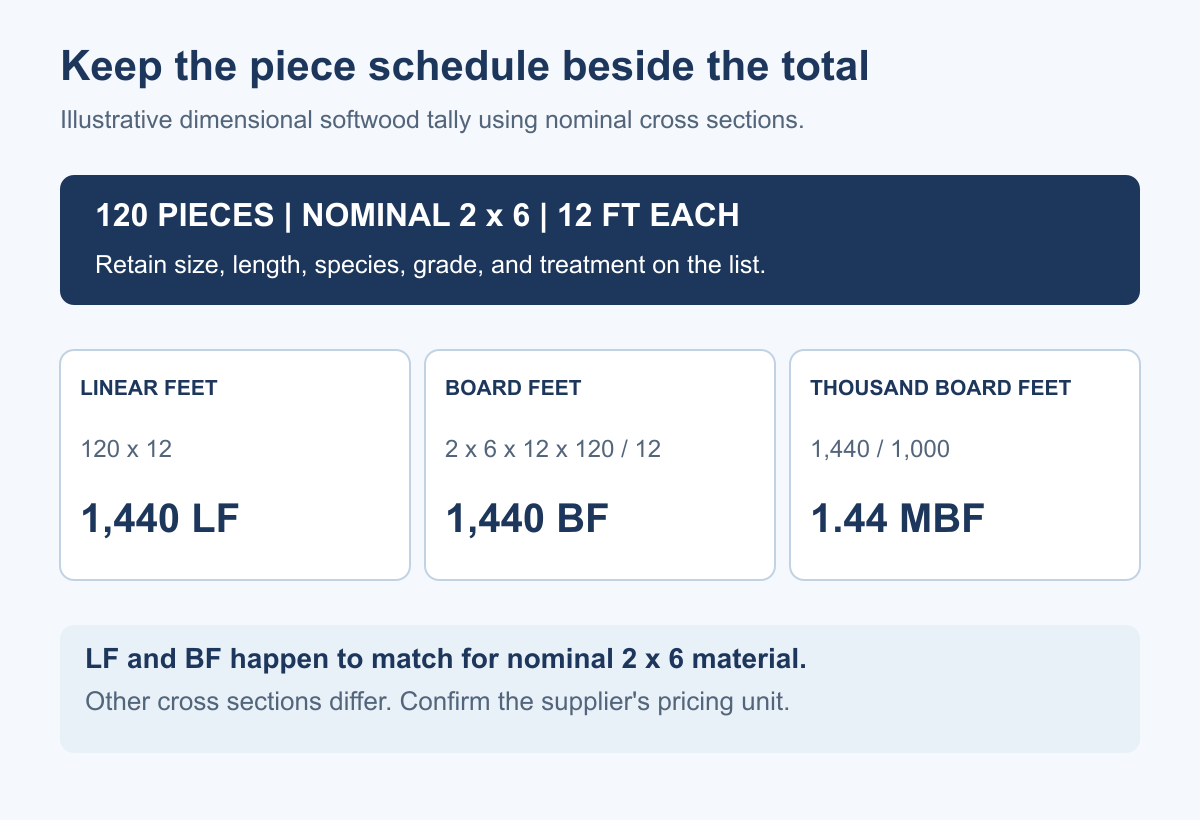
Suppose your list contains 120 pieces of nominal 2 × 6 lumber, each 12 feet long:
- Linear footage: 120 × 12 = 1,440 LF.
- Board footage: 2 × 6 × 12 × 120 ÷ 12 = 1,440 BF.
- Pricing quantity: 1,440 ÷ 1,000 = 1.44 MBF.
The LF and BF totals happen to match for nominal 2 × 6 material because 2 × 6 ÷ 12 equals one. That coincidence does not hold for every cross section. Keep the units visible when copying quantities into the quote comparison.
Retain separate length groups even if the yard also needs a combined BF total. A quote for assorted lengths needs review against the intended cuts. A board-foot total does not establish that the delivered pieces will suit each member.
3. Keep engineered wood, panels, and hardware identifiable
Engineered members need their own product descriptions. Check the specified product designation, dimensions, performance grade where stated, lengths, quantities, and location. For a built-up member, confirm whether the list counts complete assemblies or individual plies.
APA's structural composite lumber guidance describes products with qualified properties and product-specific identification. When a supplier proposes another product, ask for the exact designation and supporting information. Route the proposed change through the project's required approval process before treating it as an accepted replacement.
For sheathing and subfloor, check panel thickness, dimensions, grade, span rating, exposure classification, edge requirements, and any other specified attributes. Keep sheet counts and their area basis together. A total square footage can conceal a change in sheet size or product.
List connectors and fasteners in a separate group with their specified model or description, finish where required, and unit. Ask whether associated fasteners and accessories are included. Mark hardware carried by another supplier so it is covered once across the combined package.
4. Find out where allowances enter the list
Ask whether a displayed quantity is measured need, an allowance-adjusted amount, or the final proposed order. A list already rounded to stock pieces should say so. Otherwise, a supplier may add an allowance to a quantity that already includes one.
Keep the reason for any allowance beside the affected material. Stock-length selection, cutting patterns, handling, packaging, and the intended reuse of offcuts can change the order. Use project-specific assumptions rather than applying one percentage to every lumber product.
If the yard proposes different lengths, compare the revised piece schedule with the required cuts before accepting the price. Retain the original tally and the proposed purchase list as separate versions. This makes it easier to see whether a lower quote depends on a different quantity or cutting assumption.
The broader material takeoff guide explains how measured quantities become purchase quantities when you need to check that conversion.
5. Send every supplier the same request package
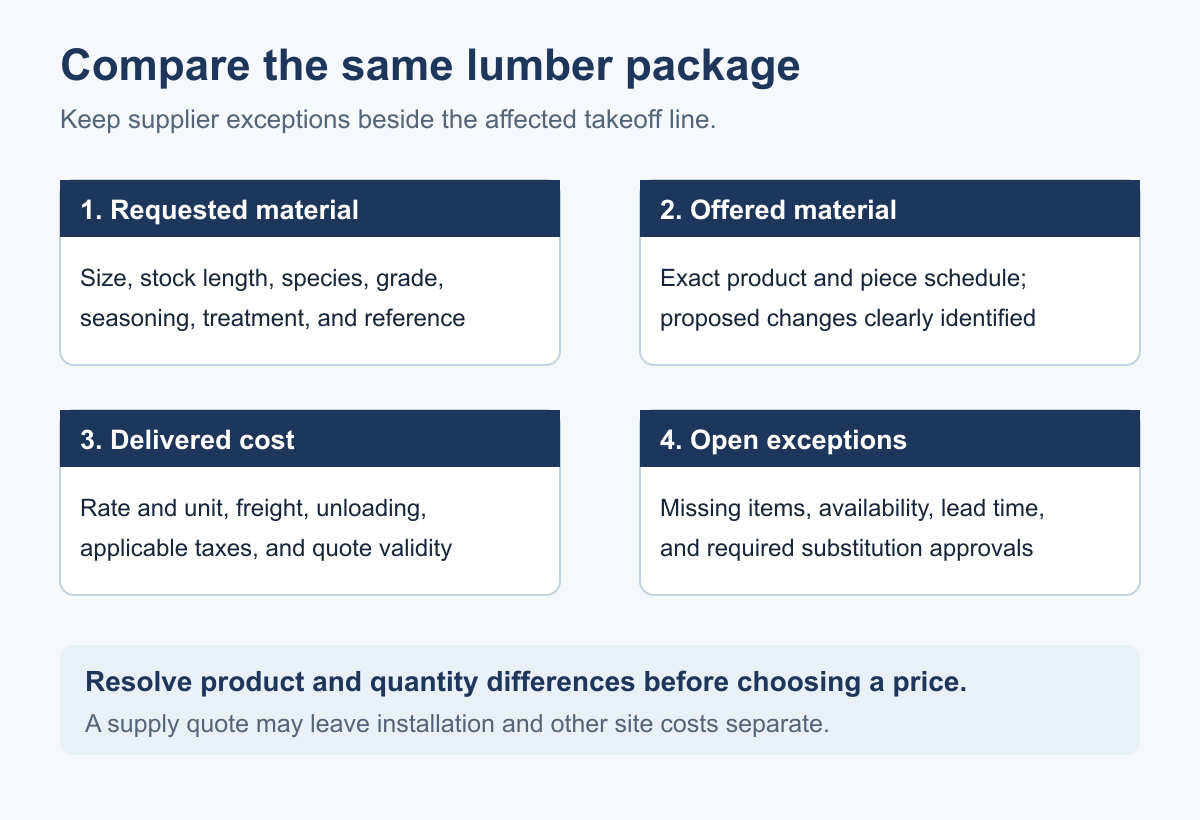
Issue one identified version of the lumber list with the relevant drawings, specifications, addenda, and scope notes. State the project location, requested delivery sequence, response deadline, and the units you want used. Invite suppliers to flag discrepancies rather than filling gaps without telling you.
Ask for line references that match your takeoff and a clear record of exceptions. The request should also ask about stock availability, lead time, quote validity, freight, unloading, applicable taxes, and any minimum order or return conditions. Have suppliers identify whether prices are fixed for the required period or subject to stated conditions.
Separate supply pricing from installation costs. A delivered lumber quote may still exclude unloading equipment, distribution around the site, protection, installation labor, or other assigned work. Check those responsibilities before carrying the quote into a complete estimate.
How should you compare the returned quotes?
Match each supplier line to the requested product and quantity first. Identify omitted groups, changed lengths, alternative products, and different allowance bases. Ask for written clarification where a supplier has combined items too broadly to check.
Then compare the cost of the same reviewed scope, including the applicable delivery charges and taxes. Keep exceptions visible instead of burying them in an adjusted total. If an unresolved product change or missing package prevents a fair comparison, record that limit before selecting a price.
Before issuing a purchase order, close the open questions and confirm the accepted product list, quantities, delivery arrangements, and commercial terms. Archive the final quote and takeoff revision together so later changes can be checked against the same baseline.
Conclusion
Read the lumber list one product line at a time, with its length schedule and drawing source available. Reconcile the units, identify allowances, and ask each supplier to price the same requirements. Resolve any changed products or delivery exclusions before confirming the order.
If you need a list organized for the yard, BidAccurate's lumber estimating services can help prepare quantities by product, size, length, grade, and treatment. Share the current plans, specifications, scope boundaries, and supplier format so the deliverable fits your bid or purchasing process.
Frequently Asked Questions
What should a supplier-ready lumber takeoff show?
It should identify the product, size, length, specified species and grade, treatment where required, quantity, and unit. Include document revisions, scope notes, and a visible allowance basis so suppliers can explain any exceptions.
Are board feet the same as linear feet?
No. Linear feet measure length; board feet measure volume. Their numerical totals match for the nominal 2 × 6 example in this guide, but other cross sections give different results. Confirm the quantity and pricing units on each quote.
Should I use nominal or actual dimensions in the tally?
The dimensional softwood example here uses nominal cross-section dimensions for its board-foot tally. Keep physical dimensions and purchase descriptions distinct, and confirm the measurement convention with the supplier for the specific material being quoted.
Can a supplier substitute another species or engineered product?
Ask the supplier to identify the proposed change and provide the relevant product information. Compare it with the project requirements and obtain the required approval before treating it as accepted. Similar dimensions alone do not establish equivalence.
How much waste should be included in a lumber order?
Use the material, cutting plan, available stock lengths, handling conditions, and purchase units to establish an allowance. Check whether the takeoff already includes it. There is no single percentage that fits every lumber package.
Does the lowest lumber quote always give the lowest package cost?
A lower total may exclude hardware, freight, taxes, or specified lengths, or it may offer a different product. Compare the same accepted scope and delivery requirements, then resolve exceptions before choosing a supplier.