
 11 min read





Key Takeaways
- Match the bar list to the current placing drawing and the authorized release scope.
- Read bar marks with size, grade, coating, shape, dimensions, and location.
- Use the referenced detailing convention rather than inventing bend deductions or lap lengths.
- Reconcile quantities and weight calculations without treating matching totals as proof of accuracy.
- Track revisions, prior releases, bundles, and delivery zones before ordering more material.
The fabricator's bar list shows the expected tonnage, but one wall zone has changed since the last review. Some bars were already released, a revised mark appears on the placing drawing, and the delivery request still refers to the old sheet. Releasing the whole list again could send superseded pieces to the site or duplicate material that is already in production.
A bar-list review connects each fabrication item to the current placing information and a defined release. You need to understand the identifying fields, check quantities and dimensional references, and preserve the history of material already authorized. This is a document and order review workflow. It does not authorize changes to structural reinforcement, splice lengths, bends, or design requirements.
Confirm the drawing basis and release status
Start with the current structural documents, placing drawings, bar list, specifications, and relevant review responses. Record the drawing numbers, revisions, issue dates, and stated review status. Follow the actual project process for resolving comments and authorizing fabrication.
Keep submission, review, and release statuses distinct. A drawing returned with comments may need a revised list before fabrication can proceed. A file labeled final by a contributor does not by itself establish that the responsible project team has authorized its use for the intended release.
Identify the exact building, level, element, pour, or zone covered by the release request. Include the planned delivery stage and any exclusions. If only the first foundation zone is ready, do not let a full-project list become an unintended authorization for later work.
Check the responsible parties and their review obligations in the actual agreements. The Mile High Flood District reinforcing specification is one public example that addresses reinforcing lists and contractor responsibility. Its particular requirements belong to projects using that specification; they are not universal release rules.
Read the bar mark as a project reference
A bar mark connects a listed piece to the placing information. Confirm how the project identifies marks and whether their uniqueness depends on a drawing, zone, release, or other prefix. The same short label in two unrelated files should not be assumed to identify an interchangeable piece.
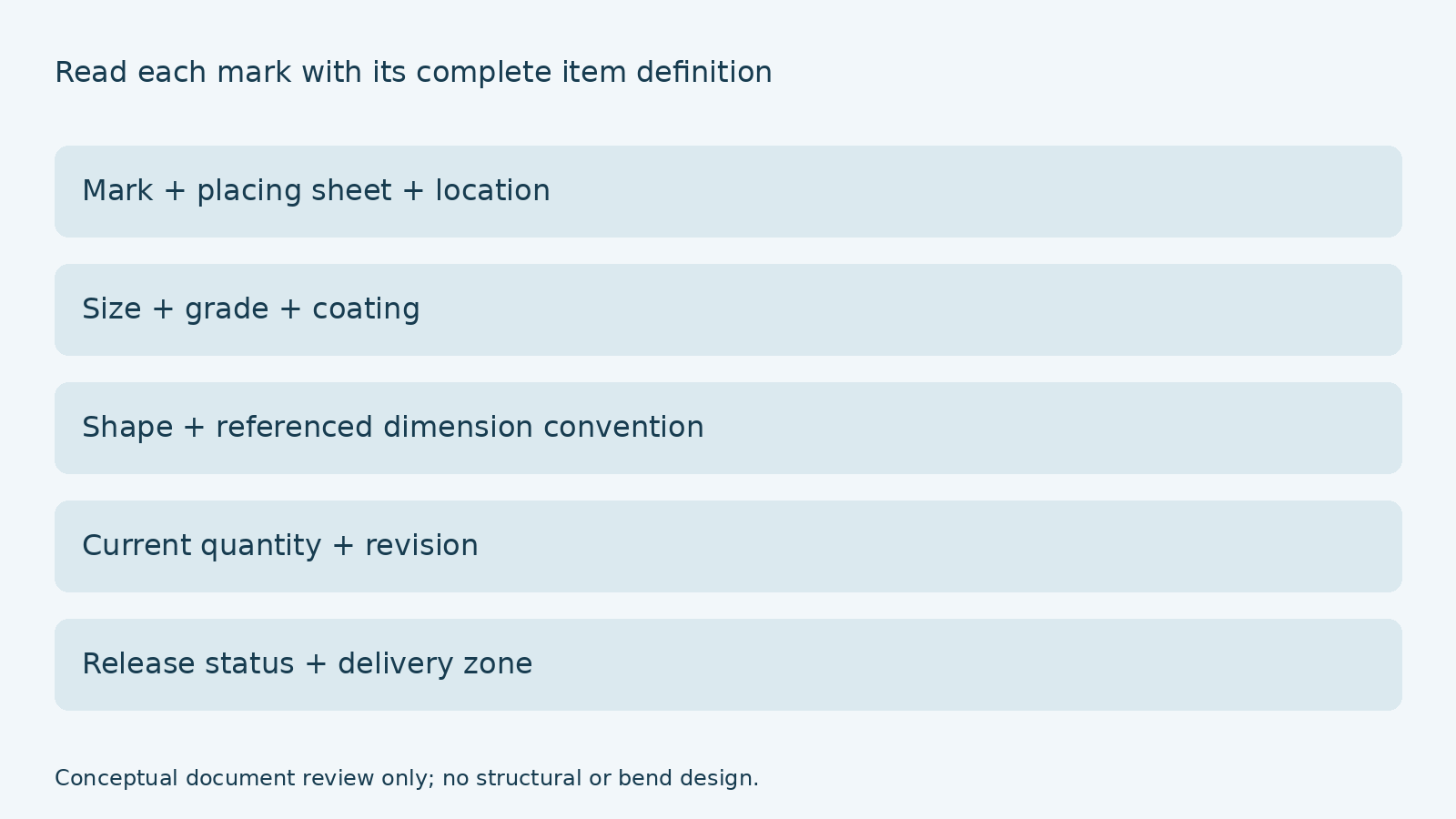
For each mark, record the bar size, material grade, coating or other specified product condition, shape reference, dimensions, quantity, and placement location. Check any notes that qualify those fields. A familiar mark format cannot replace the actual legend and schedule definitions.
Distinguish fabrication marks from markings rolled onto the steel. They serve different identification purposes. A list review should preserve both the specified material requirements and the fabrication references needed to match delivered pieces to the correct location.
Use the current placing drawing to locate each listed group. If a mark cannot be found, or the drawing identifies a mark absent from the list, log the discrepancy. Ask the responsible detailer to reconcile it before the affected item enters fabrication.
Check dimensions through the referenced convention
Read the applicable shape diagram and the convention used for its dimensions. Confirm what the dimension endpoints represent and how the list identifies straight lengths, bends, hooks, or other defined geometry. Do not transfer assumptions from a different fabricator's schedule.
The CRSI Manual of Standard Practice contents identifies separate coverage of placing drawings, detailing, bend shapes, and fabrication practices. Consult the actual referenced technical provisions for specific conventions. A contents page does not supply the bend dimensions or tolerances needed to calculate a fabricated piece.
Keep the shape reference with every dimensional check. Two pieces can have similar overall lengths but different bends or orientations. If the list and placing view disagree, retain both references and request clarification rather than choosing the version that produces the expected total.
Do not invent bend deductions, hook extensions, lap lengths, or development requirements to make a list balance. Those items require the approved design and applicable detailing basis. Route proposed changes to the responsible reviewer and preserve the resulting instruction with the affected mark.
Reconcile quantities by element and location
Check the listed counts against the placing information using a consistent location reference. Separate bars in different elements or stages even when their fabrication properties match. This helps identify whether a repeated quantity is intentional or a duplicated entry.
Review typical details and repeated conditions carefully. A note that applies to several similar elements needs an explicit count basis. Confirm exceptions, end conditions, openings, and elements that differ from the typical case before extending a repeated bar group.
Keep measurement calculations and count references with the review. If the placing drawing gives an explicit count, compare it with the list. If the count is derived from documented layout information, retain the calculation and the responsible review rather than presenting an unexplained number.
The rebar takeoff checklist addresses the broader bid package. A fabrication release review starts later in the process, with specific marks and current placing information. Bid tonnage can provide context, but it cannot replace the mark-level reconciliation needed for an order.
Check theoretical weight on a stated basis
Record the basis for listed weight, including the units, applicable unit-weight reference, and the length definition used by the list. Keep theoretical bar weight separate from package, shipping, or other quantities that a supplier may report for a different purpose.
For a simple straight-bar calculation, the arithmetic is count multiplied by listed length multiplied by the applicable unit weight. Use verified project and material data for a real check. Bent-bar lengths require the referenced detailing convention; adding visible leg dimensions without that basis can produce a misleading result.
Review the extensions by mark before comparing the total. Two errors can offset each other and leave the overall tonnage looking plausible. Group totals by size, grade, coating, and release so differences remain traceable to their source lines.
Do not adjust quantities or dimensions merely to reach a previous estimate's weight. Differences may reflect scope development, a revision, an omitted item, or another issue requiring explanation. Preserve the original estimate and identify the actual reason for the movement.
Keep couplers and accessories outside an unexplained tonnage total
Identify mechanical couplers, bar-end preparation, supports, spacers, and other assigned accessories through the drawings and specifications. A steel weight total does not show whether those items are included, excluded, or supplied through another package.
For couplers and prepared ends, preserve the corresponding bar references and specified system information. Confirm the required product and review status with the responsible team. Do not substitute a coupling arrangement or modify a splice because a different item is easier to procure.
Check support and accessory responsibilities separately from the fabricated reinforcing pieces. Review how the purchase scope treats loose items, shop assemblies, and materials supplied by others. Keep their units appropriate to the item instead of burying them in an arbitrary weight allowance.
When a supplier includes fabrication or accessory services within a combined offer, request enough breakdown to reconcile the scope. Preserve exclusions and written clarifications. An internal comparison adjustment does not revise the supplier's offer or authorize a technical substitution.
Use a revision example to avoid duplicate releases
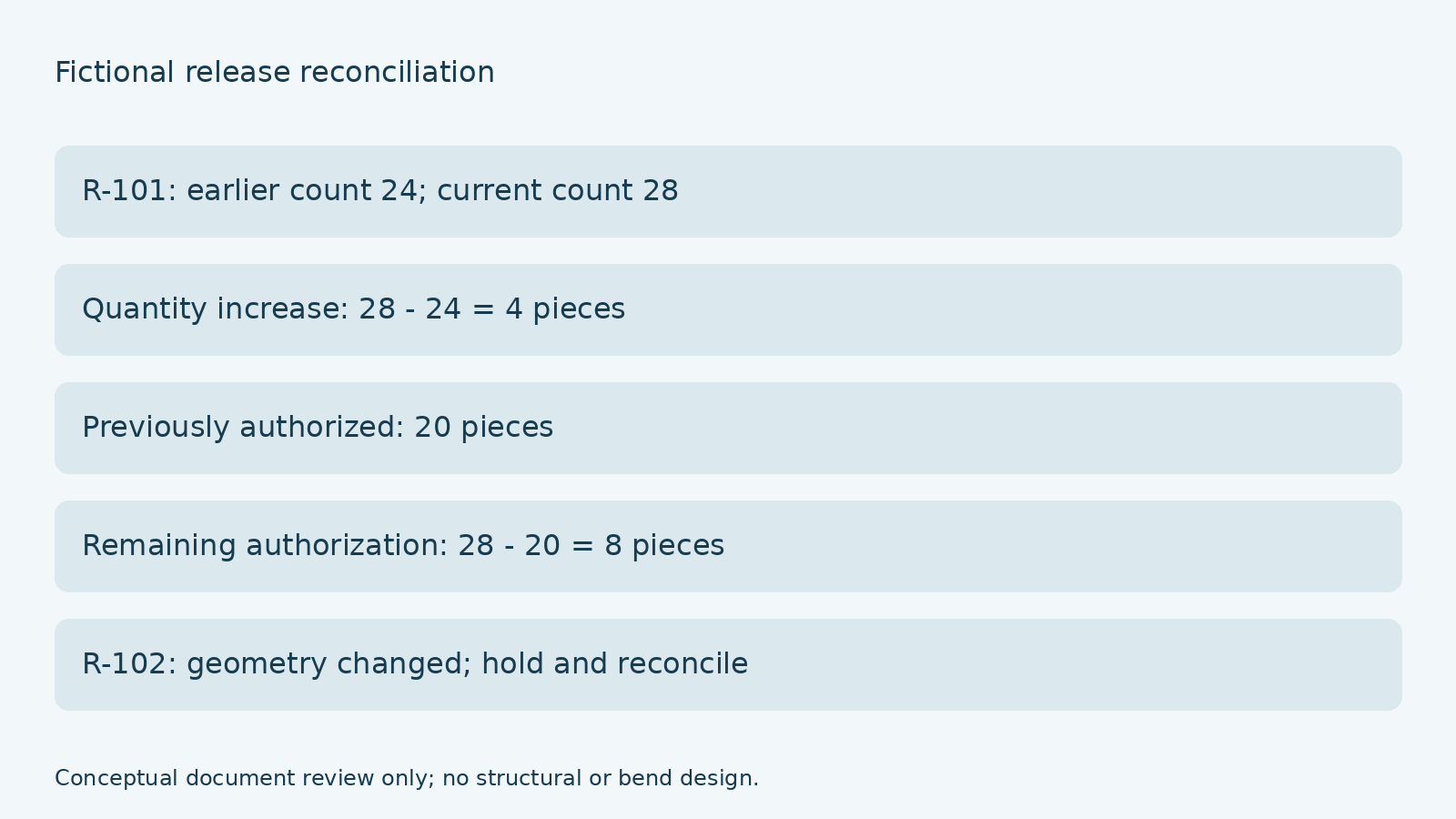
Consider a fictional straight-bar mark R-101 listed at 24 pieces in revision A and 28 pieces in revision B. Assume the current reviewed documents confirm that the size, material, dimensions, and placement purpose of this mark remain unchanged. The quantity increase is four pieces.
Now assume the release ledger shows that 20 pieces were previously authorized and the fabricator confirms their status against the same current item definition. The remaining quantity to authorize is 28 minus 20, or eight pieces. Ordering all 28 again would ignore the earlier release.
| Fictional mark | Earlier quantity | Current quantity | Previously authorized | Remaining |
|---|---|---|---|---|
| R-101, properties unchanged | 24 | 28 | 20 | 8 |
| R-102, geometry changed | 12 | 12 | Check status | Hold for reconciliation |
For mark R-102, assume the count remains 12 but the geometry changes. A zero quantity difference does not resolve the release. Identify whether earlier pieces are unstarted, fabricated, shipped, or received, and obtain the responsible disposition before authorizing the revised item.
These are document-control examples only. They prescribe no reinforcement geometry or structural change. The project team and fabricator must confirm how revisions affect actual production, identification, and replacement requirements.
Maintain a release ledger with production status
Track the current required quantity, authorized quantity, fabrication status, shipped quantity, received quantity, and open balance using the project's agreed definitions. Keep those fields separate. Authorized material is not necessarily fabricated, and shipped material is not necessarily received or accepted.
Record each release instruction with its date, responsible authorizer, drawing revision, list revision, and scope. If a release is revised or held, obtain acknowledgment through the agreed process. A new email attachment alone may not tell the fabricator which earlier instruction it replaces.
Use the drawing-revision quantity log to preserve changes against the baseline. Add the production-status information needed for fabrication decisions rather than treating the quantity difference as the entire release instruction.
Reconcile ambiguous responses before repeating an order. If the fabricator's acknowledgment is missing, confirm the known release reference and status. Issuing another full list to be safe can create two active instructions for the same pieces.
Review bundle identification and delivery zones
Agree how bundle tags connect to marks, material requirements, and placement locations. The MHFD specification provides one example of tag information used for checking, sorting, and placing. Use your actual project and fabricator requirements for the final tag format.
Match delivery groups to the installation sequence and the site's receiving plan. A shipment containing the correct total weight can still be difficult to use if pieces for several pours are mixed without clear identification. Confirm required separation and labeling before release.
Review access, unloading, storage, and handling responsibilities with the project team and supplier. Record the services included in the purchase scope. Do not assume that delivery automatically includes every site-handling activity or that a preferred sequence is already accepted by the fabricator.
Keep packing lists and receipt records connected to the release ledger. Note discrepancies by mark and bundle reference, then obtain the responsible resolution. A receiving count is useful evidence, while acceptance and technical suitability follow the project's required process.
Complete the release review before authorizing fabrication
Use a final check that follows an item from the current placing view through its list line, dimensions, quantity, and release balance. Ask a reviewer to trace at least one changed item and one repeated group. This is more informative than checking only the final weight.
Confirm that open questions have a responsible owner and a documented disposition. Keep affected items on hold where required by the project process. Do not let a general release statement silently include marks that still depend on unresolved geometry or material information.
Issue one unambiguous package containing the release reference, current list, applicable placing sheets, revision description, included zones, and required delivery information. Identify superseded instructions explicitly and retain the prior issue in the project archive.
After acknowledgment, update the ledger and distribute the current information to purchasing and field teams. Preserve subsequent revisions through the same process so the site does not receive a newer delivery while working from an older placing package.
Conclusion
A useful bar-list review connects each mark to current placing information and a defined release balance. Check material and dimensional references, reconcile counts and weights, and preserve production status before authorizing more pieces. Keep unresolved revisions visible through fabrication and delivery.
For help organizing bid quantities and supplier-review information, discuss the required scope with BidAccurate's rebar estimating team. Identify the source documents and responsible technical reviewers so the deliverable's limits are clear.
Frequently Asked Questions
Is a bar list the same as a placing drawing?
They provide related information in different forms. The list identifies fabrication items and quantities, while the placing information locates them. Read them together under the project's actual documentation conventions.
Can I release bars from bid tonnage alone?
Bid quantities do not establish a complete fabrication instruction. Confirm current marks, material properties, dimensions, counts, review status, and authorized release scope before ordering fabricated pieces.
What if the count stays the same but the shape changes?
Reconcile the changed geometry and the status of previously authorized material. A zero count difference does not show whether earlier pieces remain suitable or require another disposition.
How do I check bent-bar cutting lengths?
Use the approved shape information and referenced detailing convention. Do not invent bend deductions, hook dimensions, or lap lengths from a generic example or another project's schedule.
Does matching total weight prove the list is correct?
No. Offsetting errors or incorrect grouping can leave the total unchanged. Check individual marks, quantities, dimensions, materials, and release history before relying on the summary.
What should a staged release record include?
Record the current item definition, required and authorized quantities, production and delivery statuses, revisions, location, and responsible instruction. Reconcile the open balance before issuing another release.