
 9 min read



How Shrink, Swell, and Compaction Affect Earthwork Quantities
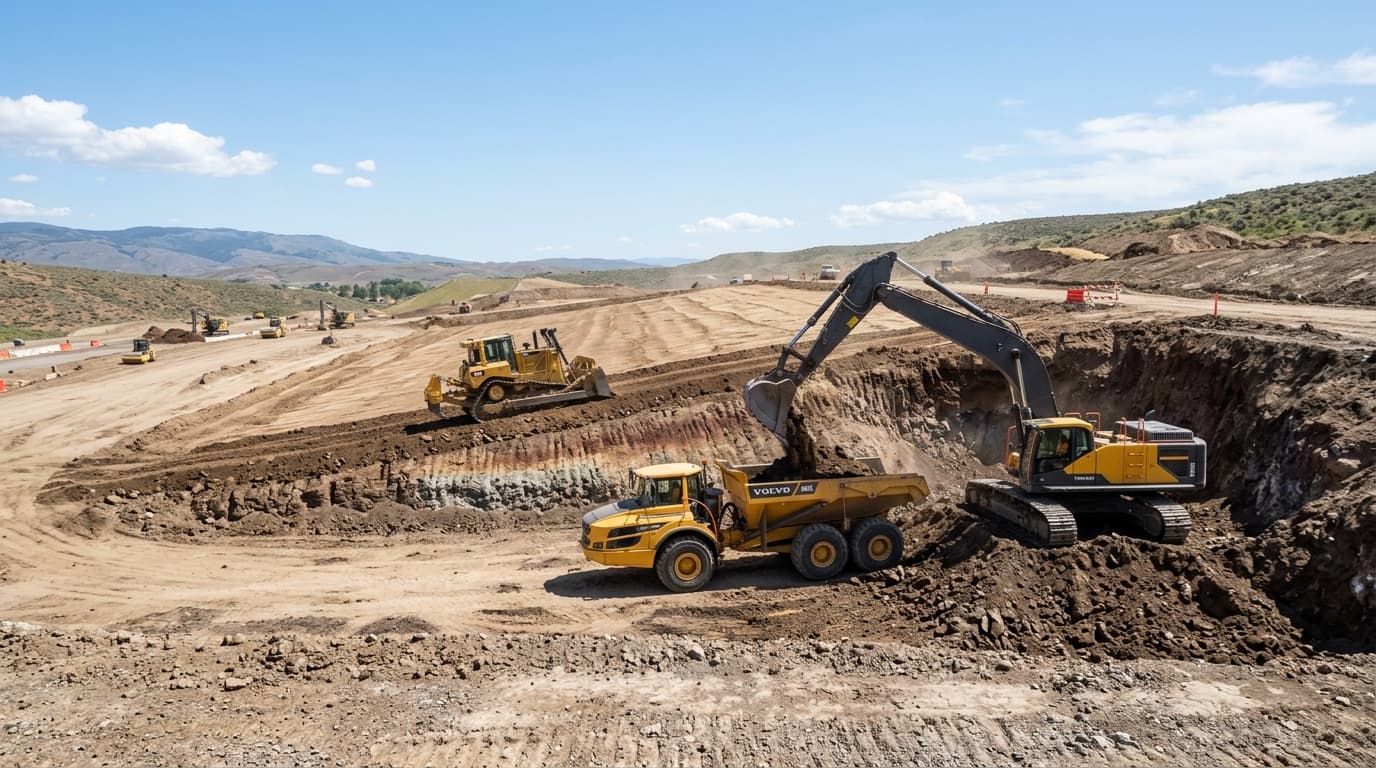
Earthwork quantities can look straightforward on a grading plan: calculate the cut, calculate the fill, compare the two, and price the work. In practice, the same soil does not occupy the same volume throughout excavation, hauling, placement, and compaction. A cubic yard measured in the ground can become more than a cubic yard after excavation and then occupy less space after it is placed and compacted.
That is why shrink, swell, and compaction are essential to accurate earthwork estimating. If these factors are ignored, an estimator can understate truckloads, miscalculate import or export requirements, and create a false cut-and-fill balance. For contractors bidding sitework, understanding the three volume states of soil—bank, loose, and compacted—is one of the most important parts of an accurate earthwork quantity takeoff.
The Three Volume States: BCY, LCY, and CCY
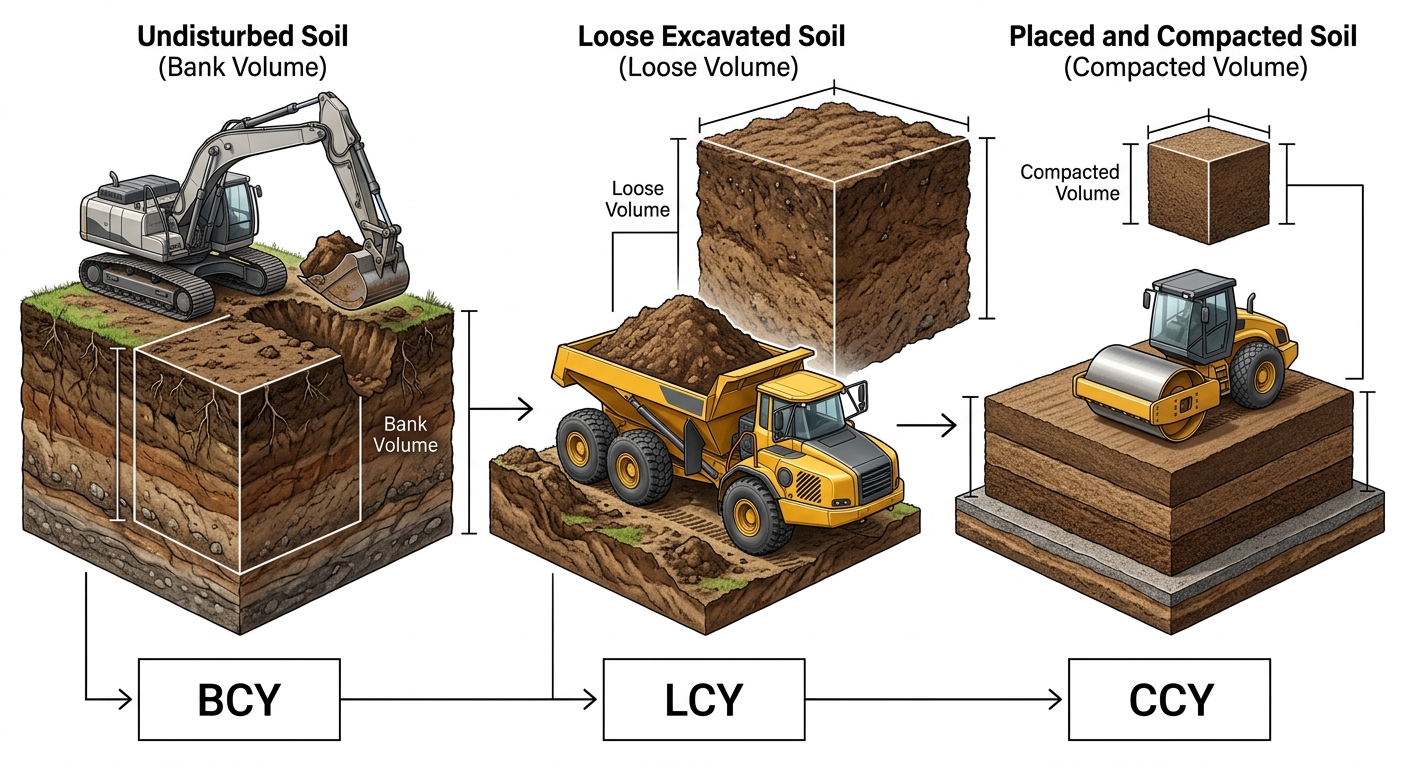
Earthwork quantities are commonly described in three different states.
Bank Cubic Yards (BCY) measure soil in its natural, undisturbed condition before excavation. Cut quantities calculated from existing and proposed grades are generally expressed on a bank-volume basis.
Loose Cubic Yards (LCY) measure soil after it has been excavated. Digging breaks the material apart and creates additional void space, so the excavated soil normally occupies more volume than it did in the ground. Loose volume matters when estimating hauling, truck capacity, temporary stockpiles, and material handling.
Compacted Cubic Yards (CCY) measure soil after it has been placed and compacted to the project requirements. Compaction reduces void space and increases density, so the finished fill may occupy less volume than the original bank material.
The key estimating rule is simple: never compare quantities from different volume states without converting them to a common basis.
What Is Soil Swell in Earthwork?
Swell is the increase in volume that occurs when soil or rock is excavated from its natural condition. When an excavator removes material, the particles are disturbed and separated. Air enters the spaces between particles, and the material becomes less dense. The mass has not increased, but the volume has.
The basic relationship is:
Loose Volume = Bank Volume × (1 + Swell Percentage)
For example, assume a project has 1,000 BCY of excavation and the selected swell factor is 25%.
1,000 BCY × 1.25 = 1,250 LCY
The plans may show 1,000 cubic yards of cut, but the trucking operation may need to handle about 1,250 loose cubic yards.
This distinction affects more than truck count. Swell can influence loading time, stockpile space, disposal requirements, haul duration, equipment production, and the total cost of exporting soil.
What Is Shrinkage in Earthwork?
Shrinkage describes the reduction in volume between the material in its bank condition and the material after it has been placed and compacted.
A simplified relationship is:
Compacted Volume = Bank Volume × (1 − Shrink Percentage)
If 1,000 BCY of reusable soil experiences an assumed 10% shrinkage when compacted, it produces:
1,000 BCY × 0.90 = 900 CCY
That means a design requiring 1,000 CCY of finished fill would need more than 1,000 BCY of bank material.
To work backward:
Required Bank Volume = Required Compacted Volume ÷ (1 − Shrink Percentage)
Using the same 10% shrinkage:
1,000 CCY ÷ 0.90 = 1,111 BCY, approximately.
This is why a site that appears balanced when raw cut and fill numbers are compared may still require imported material.
Compaction Percentage Is Not the Same as Shrinkage Percentage
One of the most common earthwork estimating mistakes is treating a compaction specification as if it were a direct volume-reduction percentage. For example, a requirement for 95% compaction does not mean that the soil loses 5% of its volume.
Compaction specifications are typically related to dry density established by a laboratory moisture-density test, such as a Standard or Modified Proctor test. The field density is compared with the laboratory reference to determine whether the placed material meets the required level of compaction.
Shrinkage, by contrast, is a volume relationship between the original bank material and the final compacted material. The two are related because compaction increases density and changes volume, but they are not interchangeable. For estimating, the shrink factor should be based on the expected relationship between bank density and required compacted density, project geotechnical information, local experience, or reliable historical production data.
How Shrink and Swell Change Cut-and-Fill Balance
A raw grading takeoff may give an estimator two numbers: total cut and total fill. Comparing those figures directly can be misleading if the cut is measured in BCY and the fill represents a compacted design volume.
Consider this example:
- Calculated excavation: 2,000 BCY
- Required compacted fill: 1,500 CCY
- Assumed swell: 25%
- Assumed shrinkage: 10%
At first glance, 2,000 yards of cut minus 1,500 yards of fill appears to leave 500 cubic yards of excess material.
But the quantities are not in the same state.
First, determine how much compacted fill the 2,000 BCY of cut can produce:
2,000 × 0.90 = 1,800 CCY
If all excavated material is suitable for reuse, the site has enough material to satisfy the 1,500 CCY fill requirement.
The bank volume actually required to create 1,500 CCY of fill is:
1,500 ÷ 0.90 = 1,667 BCY, approximately.
That leaves roughly 333 BCY of excess bank material. With 25% swell, that excess becomes about:
333 × 1.25 = 416 LCY
for export or stockpiling.
The original 500-yard “surplus” was therefore not an accurate hauling quantity. Converting volume states produces a much more useful estimate.
Swell Directly Affects Trucking and Haul-Off Costs
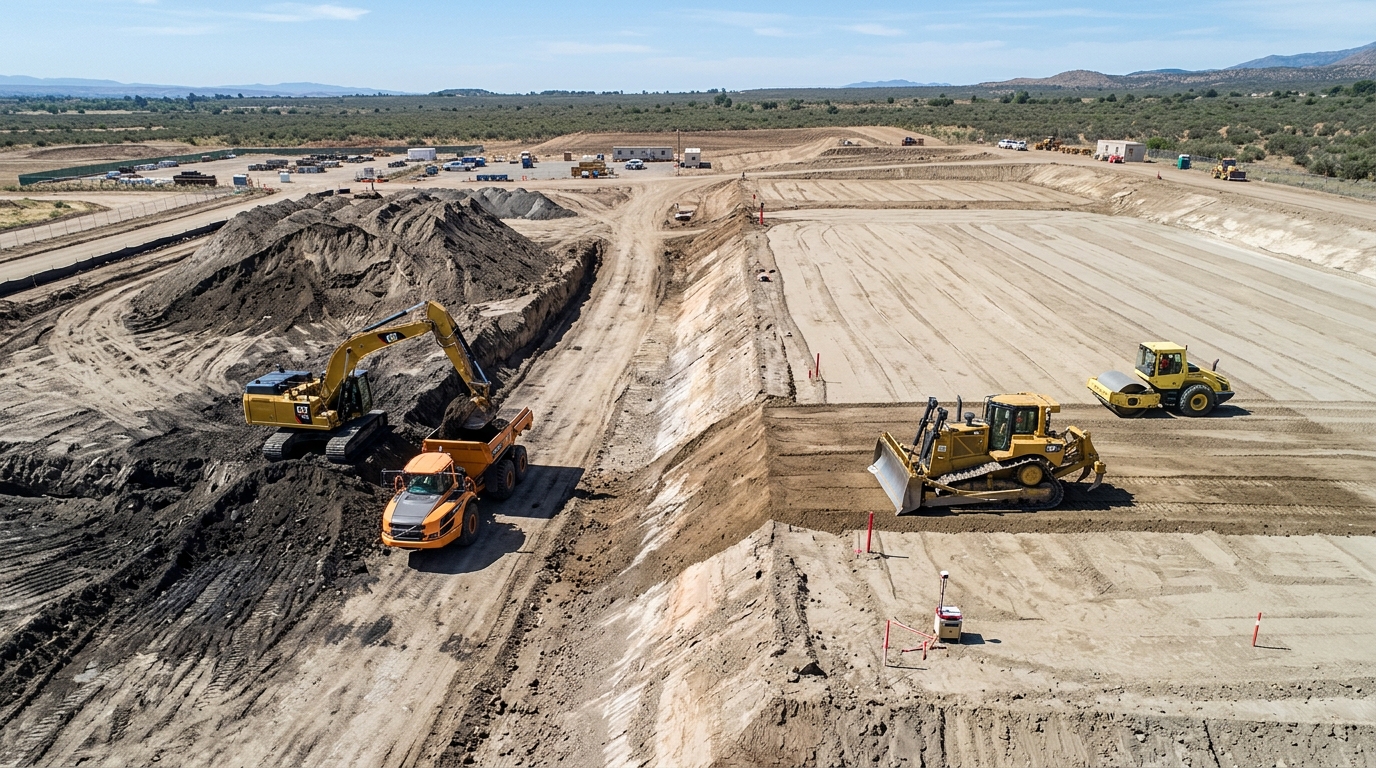
Truck capacity is based on the material actually loaded, not the volume the soil occupied before excavation. That makes loose volume critical when estimating haul-off. If 1,200 BCY of material swells by an assumed 20%, the excavated quantity becomes:
1,200 × 1.20 = 1,440 LCY
If the estimator prices transportation using only 1,200 yards, the haul allowance can be understated before the job begins.
A complete sitework estimate should consider not only loose volume but also truck payload limits, haul distance, loading and dumping cycle time, traffic conditions, disposal fees, and whether material can be reused or stockpiled on site. Volume is only one part of hauling cost, but using the wrong volume makes every following calculation less reliable.
Soil Type and Moisture Can Change the Factors
There is no single swell or shrink factor that works for every project. Clay, sand, gravel, topsoil, weathered material, and blasted rock behave differently when excavated and compacted. Moisture content also matters because it affects soil density, workability, and the ability to achieve the specified compaction.
The geotechnical report should therefore be reviewed alongside the civil and grading drawings. Useful information may include soil classifications, existing density, moisture conditions, suitability for reuse, compaction requirements, groundwater observations, and recommendations for structural fill.
An estimator should also identify material that may not be reusable, such as organics, debris, highly unsuitable soils, or material requiring treatment. A theoretical cut-and-fill balance means little if a large portion of the cut cannot be placed back as acceptable fill.
Where Earthwork Quantity Errors Usually Enter the Estimate
Shrink and swell factors are important, but accurate sitework estimating also depends on the quality of the base takeoff.
Common sources of error include:
- Comparing existing and proposed grades incorrectly
- Missing topsoil stripping or replacement
- Ignoring building pad over-excavation
- Treating unsuitable excavation as reusable fill
- Forgetting trench excavation and backfill
- Mixing BCY, LCY, and CCY in one worksheet
- Applying one factor to several different soil types
- Ignoring compaction requirements and moisture conditioning
- Pricing haul-off from bank volume instead of loose volume
- Assuming that a mathematically balanced site requires no import or export
A strong earthwork takeoff separates these quantities so the estimator can see exactly how the dirt is expected to move through the project.
A Better Workflow for Estimating Earthwork Quantities
A reliable earthwork estimating process can be organized into a few repeatable steps.
First, calculate the geometric cut and fill volumes from the grading information. Depending on the project, this may involve digital terrain surfaces, grids, cross-sections, or other takeoff methods.
Second, separate the material by type and intended use. Topsoil, structural fill, unsuitable soils, rock, trench material, and general excavation should not automatically be treated as one uniform quantity.
Third, assign project-appropriate swell and shrink factors. Prefer the geotechnical report, project specifications, test data, and documented local experience over generic assumptions.
Fourth, convert the quantities into the state needed for each cost item. Excavation may be tracked in BCY, trucking in LCY, and finished embankment or fill in CCY.
Fifth, calculate the true import, export, reuse, and stockpile requirements. Then apply equipment production, trucking, disposal, material purchase, placement, moisture conditioning, and compaction costs.
Finally, document the assumptions. If the geotechnical information is incomplete, the estimate should clearly state which factors were used and why. For contractors who do not have the time or software to build detailed grading quantities in-house, professional sitework estimating services can help convert civil drawings and soil information into organized, bid-ready earthwork quantities.
Why These Adjustments Matter to the Bid
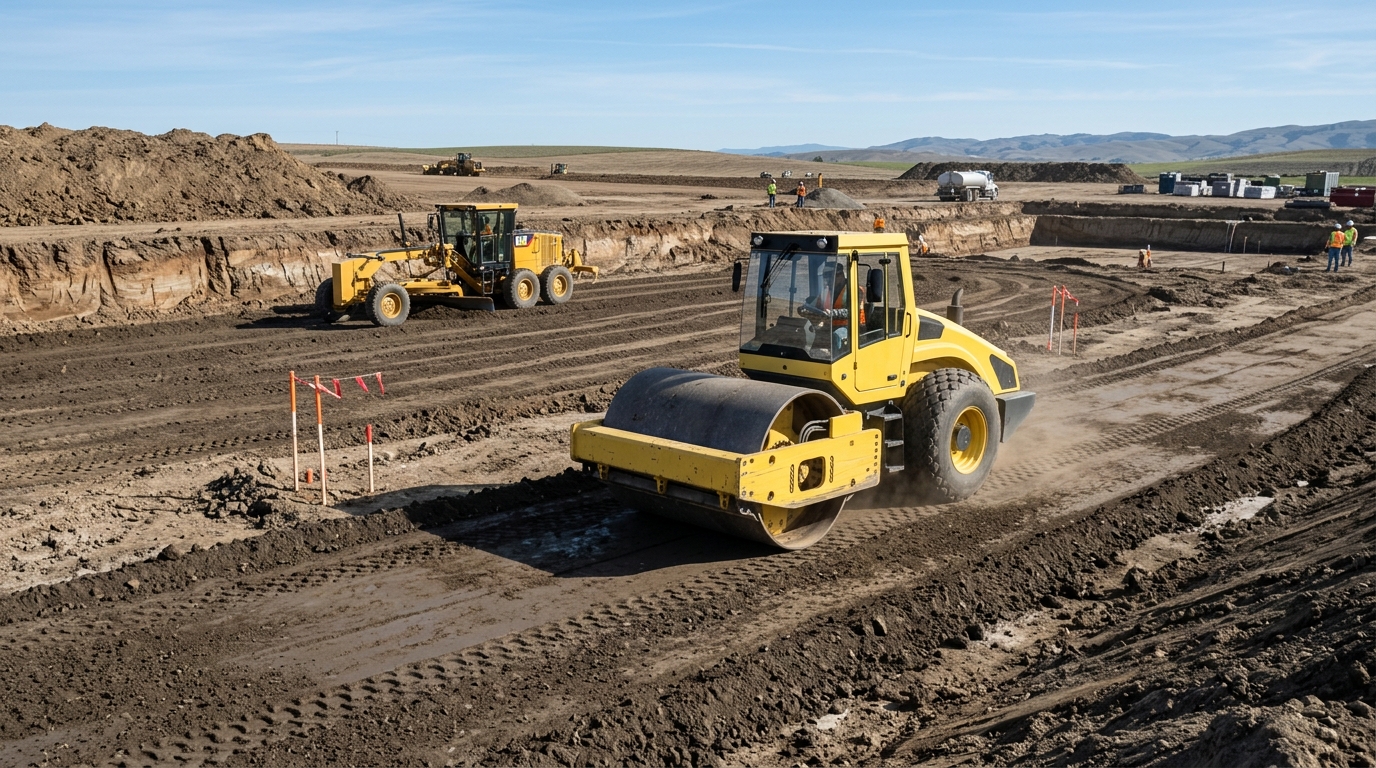
Earthwork is often one of the first major cost exposures on a project. Small quantity errors can multiply through excavation hours, loader production, truck trips, fuel, disposal charges, imported fill, grading, and compaction. Correctly applying shrink, swell, and compaction assumptions gives the estimator a clearer picture of what will actually happen in the field.
The goal is not to force every project into a perfect cut-and-fill balance. The goal is to understand the material states well enough to predict how much soil must be excavated, how much loose material must be hauled, how much compacted fill can be produced, and whether additional material must be imported or exported.
Final Takeaway
Shrink, swell, and compaction turn one earthwork quantity into several different working quantities. Bank cubic yards describe the material in the ground, loose cubic yards describe what excavation and hauling equipment handle, and compacted cubic yards describe the finished fill.
Accurate earthwork estimating depends on keeping those volume states separate, applying appropriate project-specific factors, and reconciling the result with the grading plans and geotechnical requirements.
When those steps are handled correctly, contractors can estimate truckloads more realistically, understand the true cut-and-fill balance, reduce unexpected import or disposal costs, and submit more dependable sitework bids.