
 12 min read





Key Takeaways
- Read the specified trench section before measuring bedding or backfill.
- Divide the route wherever width, depth, pipe size, material, or restoration changes.
- Use non-overlapping zones and deduct pipe displacement using its outside diameter.
- Keep net installed volume separate from delivered loose volume and supplier tonnage.
- Reconcile structures, crossings, unsuitable material, and restoration in their own scope records.
You have measured 100 feet of utility trench, but the supplier needs a material quantity. Multiplying the route by the full excavation section gives a volume that includes the pipe itself and may combine several different fill materials. Ordering that whole volume as bedding would give you the wrong purchase request.
A trench quantity worksheet needs defined zone boundaries. Start with the approved section, measure the route in consistent segments, and calculate each specified material separately. Then convert those installed quantities to the supplier's quotation basis with a stated volume or density relationship.
This method helps you prepare an auditable takeoff from project documents. The dimensions below are arithmetic examples only. They do not specify a safe trench, pipe installation, support system, or acceptable backfill material.
1. Read the trench section before measuring the route
Collect the utility plans, profiles, trench details, specifications, geotechnical information, and applicable revisions. Identify the pipe material and product, outside diameter, required foundation treatment, bedding, pipe embedment, final backfill, and surface restoration.
Different documents may use different names for the same region. Establish where each material starts and stops vertically and horizontally. A label such as pipe zone may include bedding on one project and exclude it in another. Write your measurement convention beside the calculation.
Uni-Bell's solid-wall PVC sewer pipe installation guide distinguishes foundation, bedding, haunching, initial backfill, and final backfill. Use its terminology in the context of that pipe system; the actual engineered project detail determines your quantities.
Iowa DOT Section 2552 separately addresses excavation, stabilization, bedding, and backfill materials. It illustrates why material eligibility and installation requirements belong in the scope review. It applies where specified and does not establish a universal trench detail.
Resolve conflicting dimensions or material notes through the project's clarification process. If the answer is pending, identify the assumed quantity basis and the affected route. Keep an unresolved design question out of a purchase instruction presented as final.
2. Divide the route into measurable segments
Create a route register using the project's stationing, structure numbers, or another consistent location reference. Start a new segment at a change in trench width, depth, pipe size, material requirement, surface condition, or construction method.
Follow the profile as well as the plan. Cover and excavation depth can change even along a straight plan-view route. Confirm whether your measured length is a horizontal plan distance, a sloped pipe length, or another required basis, and keep that convention consistent with the section calculation.
Choose endpoints that prevent duplicate measurement at structures. A center-to-center utility line can include portions inside manholes or vaults. Record the actual trench quantity limits and calculate structure excavation and fill separately where the scope requires it.
| Segment field | What to record | Why it matters |
|---|---|---|
| Start and end | Stations, structures, or defined coordinates | Allows another estimator to trace the measured route |
| Length basis | Horizontal or other specified measurement | Keeps profile and plan quantities consistent |
| Section | Width, zone depths, pipe outside diameter | Defines the geometry used in the calculation |
| Materials | Specified material by zone | Prevents different fills being combined in one order |
| Exceptions | Structures, crossings, treatment, restoration | Shows work outside the ordinary section |
For a varying section, subdivide the run or use an appropriate sectional-volume method with documented measurements. A single average depth should have a reproducible basis. Avoid averaging across a material boundary that needs a separate supplier quantity.
3. Keep the quantity zones from overlapping
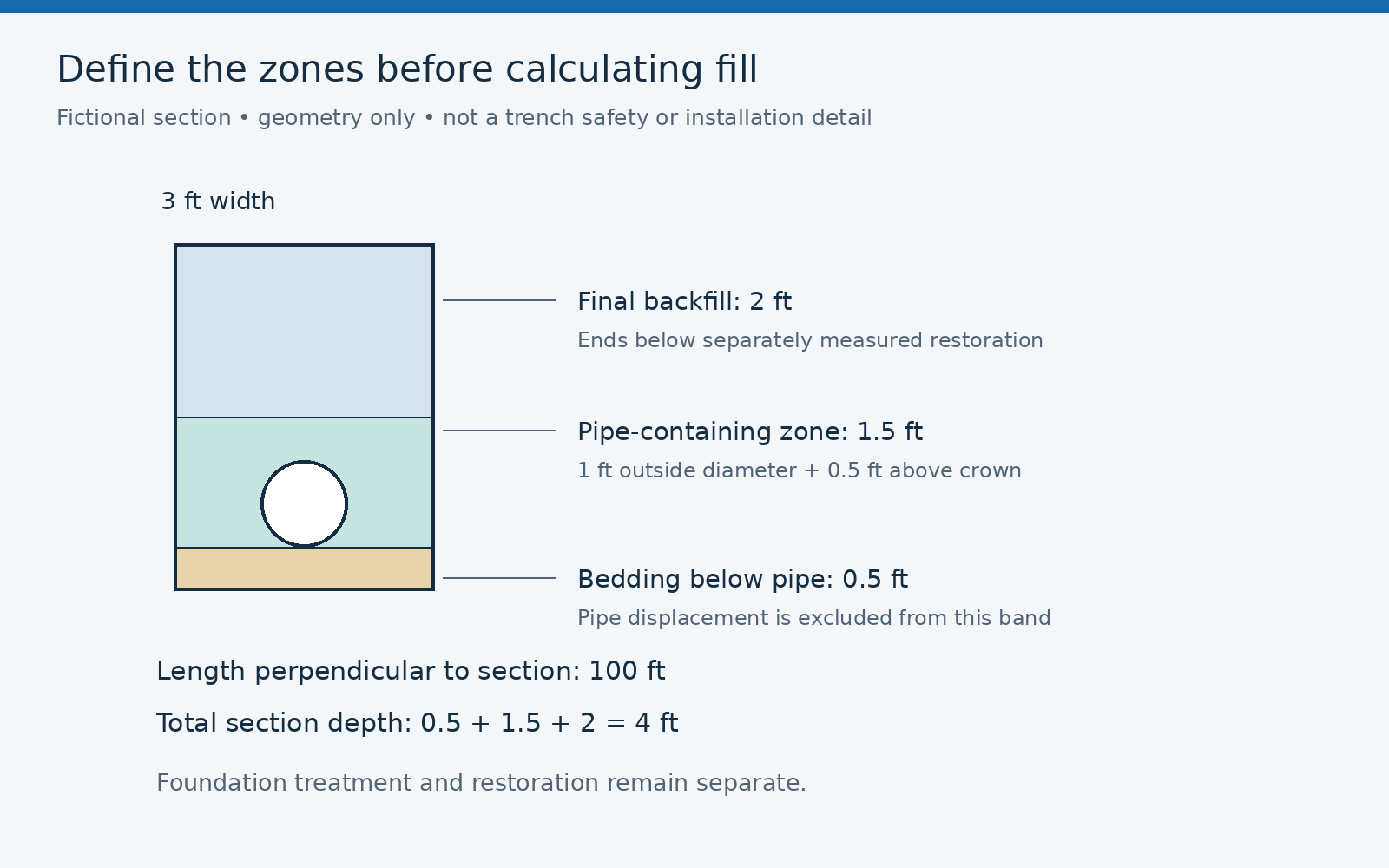
Define the bedding below the pipe separately from the material beside and above it. For this article's example, bedding ends at the bottom of the pipe barrel. The next zone begins there, contains the full pipe outside circle, and extends to a stated height above the crown.
Final backfill begins at the top of that pipe-containing zone and ends below the separately measured restoration layer. Foundation improvement below the bedding remains outside these three fill zones. These boundaries are a calculation convention for the fictional example, not installation requirements.
Some specifications group multiple regions under one material item. You can summarize compatible materials after calculating their non-overlapping volumes. Preserve the underlying breakdown so a revised section can be updated without rebuilding the whole takeoff.
Watch for two estimators measuring the same band. If one line measures bedding plus embedment and another line measures embedment again, the total will be overstated. Give every part of the section one quantity owner and one clear set of limits.
4. Calculate bedding from its defined geometry
For a rectangular bedding band with constant width and thickness, multiply width by thickness by measured length. Convert inches to feet before multiplying if the remaining dimensions are in feet. Divide cubic feet by 27 to report cubic yards.
Assume a fictional run 100 feet long with a 3-foot-wide rectangular section and 0.5 foot of bedding below the pipe. Bedding volume is 3 × 0.5 × 100 = 150 cubic feet. Dividing by 27 gives approximately 5.56 cubic yards of installed bedding.
The 0.5-foot thickness equals 6 inches. It is an example input chosen for transparent arithmetic, not a recommendation for any pipe. Obtain the required thickness and material from the actual project detail and applicable product information.
Do not deduct the pipe from this bedding band under the stated boundaries: the pipe begins above it. If your project defines bedding around part of the barrel, use the geometry corresponding to that definition instead of copying this formula unchanged.
Keep localized bell holes, foundation replacement, or other specified adjustments identifiable. Determine their treatment from the actual detail and agreed measurement rules. An unexplained allowance can hide a different scope or cause the same adjustment to be included twice.
5. Deduct pipe displacement on the correct basis
Where the fill calculation includes the pipe's full outside cross-section, subtract the volume occupied by that outside envelope. For a constant circular outside diameter, displacement is π × outside diameter squared ÷ 4 × length.
Use actual outside diameter, not nominal size or inside diameter. Products with the same nominal designation can have different external dimensions. Confirm the pipe data and keep diameter units consistent with the other measurements.
In the fictional example, assume an outside diameter of 1 foot and a pipe-containing zone 1.5 feet high. The height includes the 1-foot outside diameter plus an illustrative 0.5 foot above the crown. Gross zone volume is 3 × 1.5 × 100 = 450 cubic feet.
Pipe displacement is π × 1² ÷ 4 × 100, approximately 78.54 cubic feet. Net fill in this zone is 450 − 78.54 = 371.46 cubic feet, or approximately 13.76 cubic yards. The circular deduction belongs in this zone once.
If the quantity boundary cuts through a pipe, a full-circle deduction would be incorrect. Use the applicable partial geometry or separate the calculation into bands that you can measure reliably. Multiple pipes also need their own occupied volumes and the actual common-trench geometry.
Fittings, bells, encasement, ducts, and other components can change displacement or material requirements. Decide which are significant under the project's measurement basis and document their treatment. Do not assume a straight-pipe barrel calculation represents every special condition.
6. Measure final backfill and check the full section
Continue the example with 2 feet of final backfill above the pipe-containing zone. Its volume is 3 × 2 × 100 = 600 cubic feet, or approximately 22.22 cubic yards. The top of this band is the underside of restoration for this example.
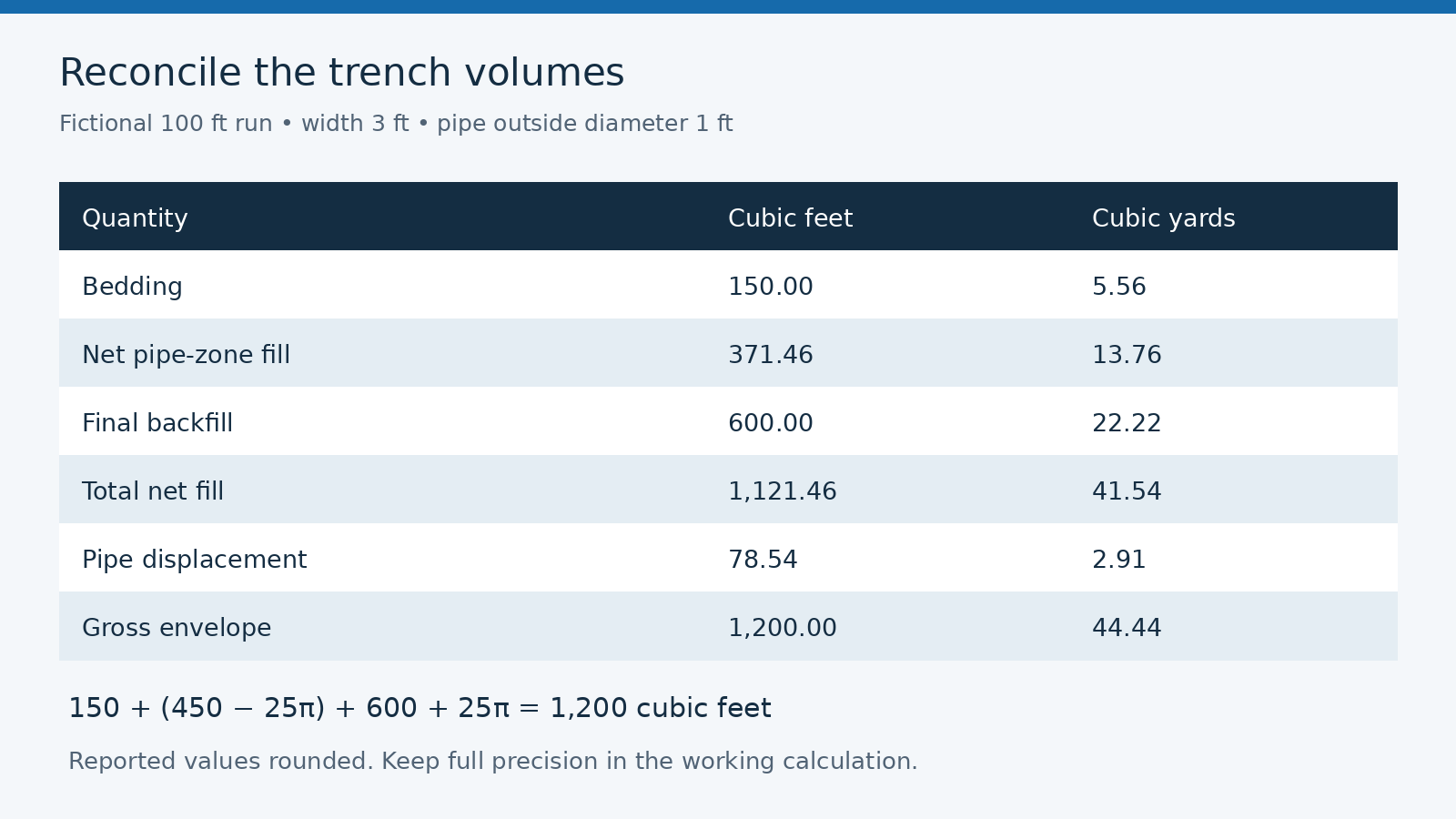
The full rectangular section below restoration is 0.5 + 1.5 + 2 = 4 feet deep. Its gross envelope is 3 × 4 × 100 = 1,200 cubic feet. Subtracting the pipe's 78.54 cubic feet leaves approximately 1,121.46 cubic feet of fill.
| Quantity | Cubic feet | Cubic yards, rounded |
|---|---|---|
| Bedding band | 150.00 | 5.56 |
| Pipe-containing zone, net of pipe | 371.46 | 13.76 |
| Final backfill | 600.00 | 22.22 |
| Total net fill | 1,121.46 | 41.54 |
| Pipe displacement | 78.54 | 2.91 |
| Gross rectangular envelope | 1,200.00 | 44.44 |
Check the unrounded calculations: bedding plus net pipe-zone fill plus final backfill plus pipe displacement equals the gross envelope. Keep full precision in the working sheet and round only the reported values. Adding already-rounded cubic-yard figures can create a small apparent mismatch.
This reconciliation tests the stated arithmetic. It does not verify whether the specified trench geometry, materials, pipe support, or installation procedure is appropriate for the site. Those requirements remain with the project's responsible team and governing documents.
7. Separate structures, crossings, and unusual conditions
Review manholes, catch basins, vaults, service connections, and enlarged work areas separately. Their excavation and fill can differ from the continuous trench section. Deduct overlapping route quantities where your measurement boundaries require it.
Check crossings for specified encasement, alternate material, separation details, or different installation methods. A short crossing may need its own section even when most of the route is uniform. Reference the controlling detail beside that segment.
Keep unsuitable-material removal and foundation stabilization distinct from ordinary bedding. Identify the information available from geotechnical reports and drawings, then state how uncertain extents are carried in the estimate. A firm quantity and an allowance should have different status.
Also review dewatering, trench protection, utility locating, monitoring, testing, temporary surfaces, and traffic requirements where assigned. These costs do not follow automatically from the fill volume. Measure or price their stated scope separately using the project's requirements.
Restoration needs its own footprint and layer review. Pavement removal limits, replacement width, aggregate base, sidewalks, topsoil, and landscaping may extend beyond the fill section. Avoid using the pipe trench width as the restoration width unless the documents support it.
8. Convert installed quantities to the supplier's quotation basis
Label the calculated volumes as net installed geometry on the stated basis. A supplier may quote loose cubic yards, tons, truckloads, or another purchase unit. Confirm that basis before converting the takeoff into an order.
If a supported loose-to-installed relationship states that 1 loose cubic yard yields 0.80 installed cubic yard, divide the installed requirement by 0.80. For an illustrative 10 installed cubic yards, the corresponding loose quantity is 10 ÷ 0.80 = 12.5 loose cubic yards. This assumed relationship demonstrates the calculation and is not a default material factor.
A density-based compaction requirement does not supply that yield relationship. Obtain an appropriate basis from the project information and supplier or technical team. The earthwork volume-state guide explains how to keep bank, loose, and compacted quantities distinguishable.
When converting to tons, confirm the applicable density, moisture basis, and whether the quantity is loose or installed. Keep the calculation and source visible. Truck capacity and legal payload limits need a separate check before a tonnage becomes a delivery count.
Record any handling allowance or purchase rounding separately. Ask the supplier to confirm material description, unit, quantity basis, freight, delivery conditions, and exclusions. The material takeoff guide helps structure that measured-to-purchased handoff.
9. Issue a worksheet another estimator can audit
For each segment, show route limits, length basis, section reference, width, zone heights, pipe outside diameter, gross volume, displacement, net material volumes, and units. Include the document issue and any unresolved assumptions.
Ask a reviewer to trace representative segments back to the plans and section. Check transitions, structure boundaries, multiple-pipe runs, and restored surfaces. Then reconcile the material summary to the segment worksheet before sending quantities out.
When a revision changes the route or profile, retain the previous measurements and explain the added and deleted quantities. The drawing-revision quantity-log guide provides a way to preserve that comparison without losing the earlier basis.
Conclusion
Measure trench materials from defined, non-overlapping zones. Segment the route where conditions change, deduct pipe displacement in the correct region, and reconcile the net fill against the full section. Convert to purchasing units only after the installed quantities and material requirements are clear.
BidAccurate's sitework estimating services can support a documented utility quantity package. Share the current plans, profiles, sections, specifications, geotechnical information, and scope boundaries so the takeoff follows your project.
Frequently Asked Questions
How do I calculate pipe bedding quantity?
Use the bedding geometry defined by the project section. For a constant rectangular band, multiply width by thickness by length, then divide cubic feet by 27 for cubic yards. Confirm that your boundaries match the specified bedding region.
Should I subtract the pipe from bedding?
Subtract pipe displacement only from a region that includes that occupied space. In this article's example, bedding stops below the pipe, so the full pipe deduction belongs in the next zone. Different section definitions need different geometry.
Can nominal pipe size be used for displacement?
Use the actual outside diameter for the outside envelope displaced by a circular pipe. Check the specified product data because nominal size and inside diameter do not necessarily equal the pipe's external dimensions.
Is trench excavation volume the same as backfill volume?
No. The pipe, structures, encasement, separate layers, and other occupied spaces affect the fill requirement. Material volume states also matter when comparing excavated soil, installed fill, and delivered material.
What allowance should I add for compaction?
Use a supported relationship for the actual material and quantity basis. A specified density percentage is not a direct volume-loss factor. Show the installed volume, conversion basis, handling allowance, and supplier purchase rounding separately.
How should changing trench depths be measured?
Divide the route into suitable segments or use a documented sectional-volume calculation. Preserve the profile references and material boundaries so the reviewer can reproduce the measurement and see where the quantities change.